"And Elves, sir! Elves here, and Elves there! Some like kings, terrible and splendid; and some as merry as children."
- The Fellowship of the Ring, Book Two, Chapter One: Many Meetings
It was the hour before dawn and pale sunlight shimmered above the rim of the eastern hills; a grey mist curled over the slow waters of the Lhûn, and the twilit world was silent save for bird-song amidst the rustling leaves. Feveren was clad once more in his familiar forest-garb; his gifted robe and cold weather clothing were stowed within his pack, together with the shortsword with which Laenin the Glade Watcher had furnished him. The coinpurse given to him by Mibrethil was tightly tucked into his belt, and a merry song was upon his lips.
He had forgone the hard pavement to walk along the grassy verge that grew between the road-wall and the brink of a steep ridge that ran along the riverside, and the morning dew upon the growing grass was cool and damp beneath his feet; through his soles he felt the burgeoning of new life within the earth. The air was filled with the fresh green smell of Spring and the young elf took a bracing breath, delighting in the vigour it brought to his body and spirit.
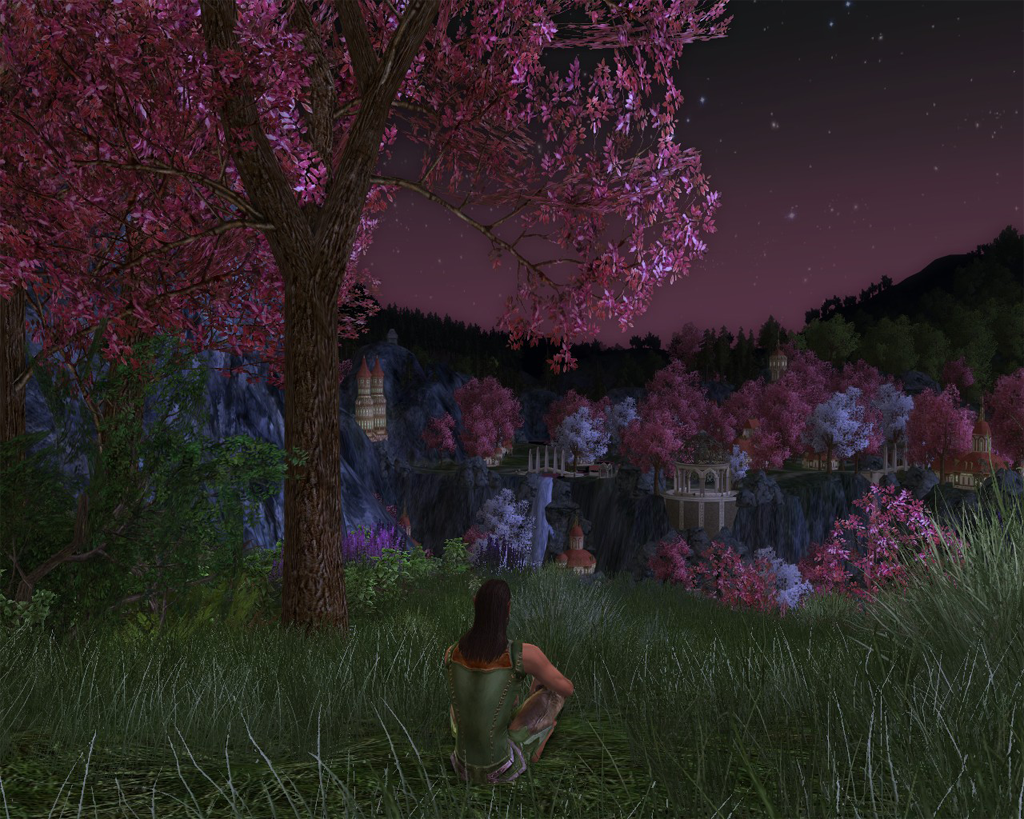
A wide stream cascaded down from the heights of Limael's Vineyard to the west, over which a stone bridge arched ere its waters fell in yet another loud torrent into the vale of the Lhûn below. Crossing over, Feveren came upon a grove of trees that overlooked the misty river and the waterfall, and beneath their budding branches he set down his gear and sat down on the grass to watch the stars fading in the growing light. The music of the foaming water filled his ears, and brought to his mind the high falls in his forest home where the sweet waters of the Brilthor tumbled down from the vales of Ered Lindon, to pour into a tree-shadowed mere where his kin made their abode in the warm days of Spring and Summer.
This remembrance brought a smile to his face, for they had long named it "Nen Echui"1 in jest, but they later deemed that it was perhaps indeed a foretelling: for when he and Faethurin were born, the arrival of the two elf-boys had brought the full count of elves in the clan to twelve dozen, and hundred and forty-four was the number of the Unbegotten,2 the First Elves. Alas that with the passing of the years, that number had dwindled for his kin.

His thought turned to the time he had spent in Celondim: Autumn had faded into Winter, and then stirred to Spring while he lingered in the elven-city. He was surprised to find a slight heaviness lay upon his heart from parting with his new-found friends, yet there was also gladness for the friendship he had found unlooked-for amongst strangers. In his forest-home he was well loved by his Elven-clan, and most of all by Gladlin and Gledhril, his father and mother, but since the sudden departure of Faethurin to the Blessed Realm, there was no other that he truly called his friend; for although many of his clan were begotten in the Third Age of the World, and were therefore young by elven-reckoning, Faethurin had been the only one who shared his short count of years and whom was as a brother to his heart.
For they had known the mind of one another since they could speak,3 and for one and twenty years they had shared their thoughts: their hopes and dreams, joys and fears. In those days of bliss they thought that for all their long elven-lives they would have each other's companionship, but now he alone was travelling the long road they had together planned; indeed, it was in the memory of his lost friend and for the promise he had made, that Feveren now trod this lonely path.
The young elf heaved a sigh. Maegamel and Thavroniel had both bemoaned his leaving as untimely, for they said that six short months left their teaching incomplete. They, who had spent long ages of the world growing in the wisdom of their craft, chided him for his hastiness; but while he was grateful for their teaching, in his mind he did not deem himself a healer despite the inborn talent handed down from Gledhril. Nor did he desire to spend what years he had remaining to explore Middle-earth in study. Why, he wondered, did these elder-elves not understand his wanderlust, even while his younger parents had heartily consented to his quest?
Indeed, to his mind the Elves of Celondim seemed stern and grave when measured against his merry woodland kin. Was this, maybe, because the rising shadow in the East had not fallen over the greenwood west of Ered Lindon? Or perhaps the hearts of his kin were lighter for they were not yet heavy with long, long memory? But the elders of his clan were not young, and yet they were often as merry and carefree as elf-children too.
Feveren watched the bright rim of the Sun creeping up behind the purple hills, while the joyful songs of sparrows and finches joined with the feathered choir that sang glad greetings amidst the boughs. Selcheneb the lore-keeper, he mused, was indeed older that the Sun Herself,4 for she was of the Nandor who had in the Elder Days5 taken Denethor son of Denweg6 as king in Ossiriand; yet her ancient heart held more mirth than the dour High-elf Golphedinir who yet named Feveren "Avar" as an affront. Try as he might to befriend the Master of Apprentices, the High-elf had shunned his advances, and thus the elf-lad deemed him an unfriend and steered clear of him as far as possible.
This form of strife was new to Feveren, and it was wretched to his heart for he knew not its cause; he guessed only that once upon a distant time the old Elf had suffered some unknown hurt by the hand (or heart) of an Avar, which he could neither forget nor forgive. Nevertheless, it grieved the young elf, for in the greenwood of Harlindon there mingled together in his clan Green-elves and Grey-elves and Wild-elves, and they were altogether his kin. To their minds they were all but Elves in kinship and friendship, and indeed they deemed themselves all "wild" for they had taken no king nor lord since Celeborn had forsaken Harlindon long ago.
In matters of lore Selcheneb had the last word, but these were few and far between, and she chiefly presided over ritual feasts and merrymaking like Feveren's rite of passage, or the grievous ceremony that bade a final farewell to the spirit of Dimaethor after his body had perished. But in all other affairs the elders held council, and they hearkened to the voices of the clan when making choices for the common good.
 He lay back and gazed up at the lightening sky. "Joyous spirit" he had been named, but lately his heart seemed to often turn to sadness.
'Too often!' he thought wryly. What indeed would Faethurin say if he could read now the thought of his light-hearted friend?
'He would mock me,' came the answer in his mind, 'And roll me over to tug my toes until I squealed in mirth!' He laughed aloud at the picture in his mind. But that was the memory of his friend from thirty years before, and not for the first time Feveren wondered if Faethurin had changed now he too was full grown. And he remembered also the speech they had often shared about this very journey that they would take together when they were grown; their "quest" they had called it. For they were the only elf-children among their clan, and to their minds it was in part to show their elders that they were as mighty as the heroes in the beloved songs and tales of old, and were children no longer.
And yet he had had a purpose of his own, for while the people of Faethurin had long dwelt in Doriath ere the first rising of the Moon and Sun, the forebears of Feveren were of the Nandor, who in song and tale were named "the Wanderers"7 ere they came to the Land of Seven Rivers, and he thus deemed it was in the nature of his people to wander in the wilds beyond the mountains. But Faethurin had said that they were both of the Lindar,8 whom had been named the Teleri,9 "the Last-comers", who tarried on the Great Journey for they were unwilling to forsake Middle-earth; and it was his thought that the two elf-boys might linger in the world until their clan at last crossed over the Sea. But indeed, in the mind of his friend Feveren had seen that the heart of Faethurin had, in truth, hoped they would never depart, and that they would remain in Middle-earth until the world's ending!
Feveren smiled fondly at the remembrance of their youthful folly, but in his eyes tears glistened. Brushing them aside, he stood and shouldered his pack. The Sun was fully risen and a fair morning had dawned, shimmering above gleaming mists on the river. It was time for him to bid farewell to the glad grove and the falling waters, and to be moving on to Duillond. But his secret thought took shape in a song of old:
Come home, come home, ye merry folk!
The sun is sinking, and the oak
In gloom has wrapped his feet.
Come home! The shades of evening loom
Beneath the hills, and palely bloom
Night-flowers white and sweet.
Come home! The birds have fled the dark,
And in the sky with silver spark
The early stars now spring.
Come home! The bats begin to flit,
And by the hearth 'tis time to sit.
Come home, come home and sing!
Sing merrily, sing merrily, sing all together!
Let the song go! Let the sound ring!10
* * *
1. Nen Echui is the Sindarin rendering of Cuiviénen, "Water of Awakening", where the First Elves awoke.
2. "And so it was that the Quendi ever after reckoned in twelves, and that 144 was for long their highest number, so that in none of their later tongues was there any common name for a greater number."
- The War of the Jewels, "Quendi and Eldar: The legend of the Awaking of the Quendi (Cuivienyarna)
3. "The Eldar grew in bodily form slower than Men, but in mind more swiftly. They learned to speak before they were one year old; and in the same time they learned to walk and to dance, for their wills came soon to the mastery of their bodies."
- Morgoth's Ring, 'The Laws and Customs Among the Eldar'
4. "Elves (and Hobbits) always refer to the Sun as She."
- The Lord of the Rings, The Fellowship of the Ring, "At the Sign of the Prancing Pony", footnote
5. "In the Fourth Age the earlier ages were often called the Elder Days; but that name was properly given only to the days before the casting out of Morgoth."
- The Lord of the Rings, Appendix B: The Tale of Years
6. "Lenwë is the form in which his name was remembered in Noldorin histories. His name was probably *Denwego, Nandorin Denweg. His son was the Nandorin chieftain Denethor."
- The War of the Jewels, "Quendi and Eldar: The Clan-names ..."
7. "Other names in song and tale are given to these peoples [...] The Nandor are the Host of Dan, the Wood-elves, the Wanderers, the Axe-elves, the Green Elves and the Brown, the Hidden People [...] and those that came at last to Ossiriand are the Elves of the Seven Rivers, the Singers Unseen, the Kingless, the Weaponless, and the Lost Folk, for they are now no more."
- Morgoth's Ring, "The Later Quenta Silmarillion: Of the Coming of the Elves"
8. "The third and greatest of the three hosts of the Eldar on the westward journey from Cuiviénen, led by Elwë (Thingol) and Olwë. Their own name for themselves was Lindar, the Singers; the name Teleri, the Last-comers, the Hindmost, was given to them by those before them on the march. Many of the Teleri did not leave Middle-earth; the Sindar and the Nandor were Telerin Elves in origin."
- The Silmarillion, "Index of Names"
9. "The greatest host came last, and they are named the Teleri, for they tarried on the road, and were not wholly of a mind to pass from the dusk to the light of Valinor."
- The Silmarillion, "Of the Coming of the Elves and the Captivity of Melkor"
10. The Annotated Hobbit - Douglas A. Anderson
 |
xii |
 |