'Indeed in nothing is the power of the Dark Lord more clearly shown
than in the estrangement that divides all those who still oppose him.'
- Haldir, The Fellowship of the Ring: "Lothlórien"
It is well that I tarried for a while in Duillond, for to my delight my delay was richly rewarded! Two woodland companions have chosen to join me upon my road, unlooked-for: Glavror, a merry sparrow with a wagging tongue, who deems himself both messenger and guide; and Gwedal, a great wild boar who has deigned to bear me as his rider. Their simple friendship has lightened my heart, for it has been long (or so it seems) since I bade farewell to the forest friends of my homewood. But our meeting was not by chance, for unbeknown to me, my beloved parents set the birds and beasts of the wild to watch over my footsteps! Eight times has the Moon grown to full since I left my home, and yet even after twelve-score days they have not failed in their trust; my heart tells me their faithfulness should be returned in-kind and more besides.
And our meeting was well-timed, for verily a steed is the answer to my plight, and the fleet feet of my new friend will hasten my passage over the wide and wild Westlands. Indeed, I had a mind to try a horse from the stables that stand in every Elf-haven I have been, but I am unused to beasts that have been tamed and trained by the hand of another, and to my mind it seems that they are bred and raised to be our servants even if we love them as friends. But the horses with whom I have spoken are content in their service and their hearts are glad, so if needs must I would surely ride; but I would much rather befriend a wild heart and open mind, as Fethurin and I were shown when we were but elf-children learning the ways of our people in the greenwood.
Alas, Gwedal could not be ridden bareback for his stiff bristled mane would rub my me raw, nor would a saddle-blanket avail. It took but a fortnight for Colchyl, the Stable-master of Duillond, to fashion a simple saddle and bridle to fit his girth (amid much mirth and merriment, for never before had he crafted such a thing!), and in that time the doubt fell from my mind and I resolved to see the mansions of the Dwarves ere my feet turn toward Lake Evendim.
Now the road from Celondim to Duillond trails to the north and east, following the course of the Lhûn and bending away from the long high spine of the Ered Lindon Luin that ranges far into the north; three leagues out of Duillond it turns westwards away from the river and thence leads on to Gondamon. But this road, I knew, led into peril for it runs past the mouth of Raith Teraig, the mountain pass to the Grey Havens, which I was forewarned is held now by goblins allied with the traitorous Dourhand Dwarves.
Thus in the dim hours ere dawn we bade farewell to Dorongúr's haven. The Moon was five days past his full and he yet hung in the lightening sky; only after the road turned to the west and began the long sloping climb to the lowlands, did he sink behind the gathering clouds that crowned the far-off peaks. The air grew cooler the higher we rode, but the rising Sun shone warmly upon my back and my mind was set at ease; for it was my thought to march during the bright hours of day when goblins hide from her shining face, and it was my fear that a grey sky would dull her potency and abet my foes. In my heart I trusted to hope that no Dourhand bandits would waylay us!
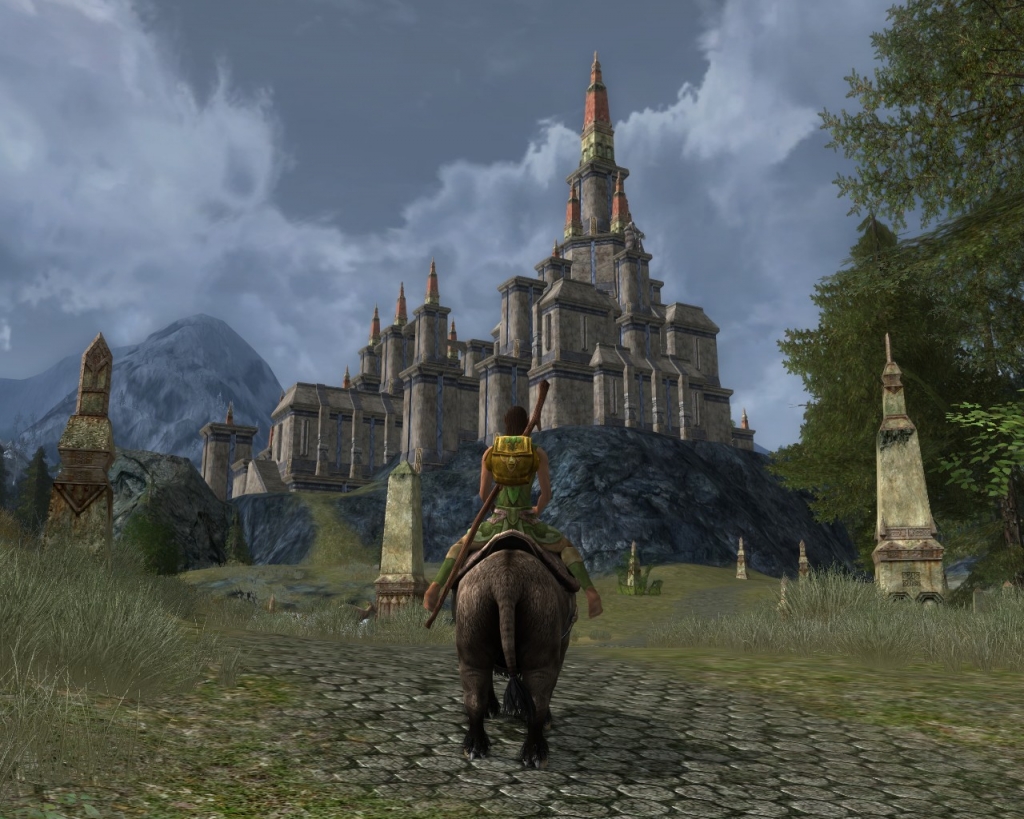
Indeed, six swift leagues atop Gwedal's broad back brought me from Duillond to the forbidding walls of Gondamon without mishap, though a pall of cloud had gathered at the last and the sun shone fitfully. In wonder I gazed upon its might, as shafts of morning sunlight broke through the clouds behind me and burnished the dull grey stone of its tall walls with pale gold. Now this is the first place I have seen in my brief lifetime that was built not as a haven, but a mighty fortress, and even gilded by the Sun it was unseemly to my woodland eyes. I have grown accustomed to elf-cities fashioned in the High-elven manner (not that I have grown used to city-dwelling!), which recalls the soft flowing lines of all that grows and is glad. But the stonework of Gondamon is utterly unalike. Stern and unyielding, it is shaped by hard lines and sharp corners, and all its forms are rigid and exact. The battlements reach up to a great height, and it seems strange to my mind that a short people would build so high (though in nature they seem much alike their works!)
It is my thought that elven-craft esteems that which grows, but dwarven arts honour that which is made, and I wonder how Gondamon looked aforetime ere the Dwarves rebuilt it. For it is told that it was a stronghold of the High Elves ere the fall of Edhelion, and the Longbeards afterwards rebuilt the forsaken fortress to their own liking.1 Little now remains of the elven design, and I wondered if this is to be the doom of all fair elven settlements in Middle-earth after the last Elf has crossed the Sundering Sea.
To my mind it seems this may be a better tale than falling into ruin, but in the elven ruins I have thus far beheld, the love the Elves held for the land can yet be felt, even when those ruins were defiled by foul goblins. But this is not so in Gondamon: well-nigh six hundred years of dwarvish abode have swept it clean of its elvish virtue. Why this is so, I cannot guess, but in my speech with Athal in Nen Hilith it seemed to me that though the folk of Durin love not the green earth in the manner of the Elves, their love for the living stone within its deeps is just as great. But wherefore one form of love should drive forth the other, I know not.
Yet my heart is glad that my kin built no houses of stone, doomed to refurbishment or ruin. And in the swift passing of the years the stuff whereof our woodland dwellings are fashioned will return into the earth whence it came, leaving no lasting trace of our people save in the memory of rock and tree. Perhaps the love with which we nourish our land will linger long ere it fades, after we who made the land are no more; but now I wonder what will be lost when the hearts of my people are forever removed from the greenwood that made us in return? It is not long in the reckoning of days since I set out from Harlindon, yet deep in my heart there is ever a quiet yearning for my green-shadowed home; but I know that one day, if fate is kind, I shall indeed return. There is no returning from Tol Eressëa! What enduring sorrow will our parting bring?
Indeed, my thought sometimes accords with Fethurin, who had a mind to linger ever in Middle-earth until the world's ending. It is a wry fate that it is my love for my friend that draws me to the Lonely Island (though verily I have not the heart to fade into shadow and memory!)2
* * *
Gwedal I bade rest in a nearby forest of dark fir, for I had no wish to debate my choice of steed with the stable-master who, I deemed, would be ill-pleased to host a wild boar. Besides, my friend is better-off rooting for his own fare (indeed, his kindred can readliy find food almost anywhere, which is a great virtue in a steed!) Glavror is tucked safe and silent within my tunic, for I have seen hunting hawks circling high in the blue fields of the sky and I fear to lose him. The warmth of his feathers nestled against my breast lightened my heart, but now, alas, a shadow has befallen it!
For it seems my visit was ill-timed and the gleaming outer walls I at first beheld belied the darkness that lay behind. For there has been needless strife between the Elves and Dwarves of Gondamon, which though resolved has left each distrustful of the other. Their tale is that by the devices of the Dourhand outlaws and their goblin allies an Elven-prince was taken, but the Elves were deceived and in their dismay charged the Longbeards for the misdeed, and thus betrayed the trust long held between them. Though he was rescued and the Dwarves absolved, the blame that the Elves first lay upon them cannot be easily forgotten, nor will they forgive the affront. There is an ill-mood here, and therefore it is my thought to not tarry long in Gondamon.
Alas! In these darkening times, such strife between the enemies of Mordor can only serve to aid the Dark Lord, for it is said that doubt and mistrust are his chief weapons, and by his arts friends become estranged. Now am I ever the more grateful for my sheltered life west of Ered Lindon, for such discord is unknown to my kin or to our friends. (Although, truth be told, I know one Grey-elf elder from Doriath aforetime who has little love for the High-elf Exiles!)
I was given food and wine by a gentle loremaster named Ráthorm, and she lamented the long bitterness between the kindreds.3 And I told her I knew well the tale of the Nauglamír, for my kin of old had played in it a part, but it was only one dwarven clan that alone sacked Menegroth long ago. Wherefore would the whole of each kindred now bear ill will? But she said that indeed those deeds of old shared some part of the blame4, but not all; and so she told me a grim tale of Beleriand that was older still, of which I had never heard tell:
Ere the first Elves of the Great March passed the Ered Lindon into the Country of Balar, there dwelt in secret small groups of exiled Dwarves west of the Sirion, who were banished thither by their kin. Never had the eyes of Elves beheld the race of Durin, and they knew not what assailed them by ambush or by stealth in the night; thus they deemed them to be cunning beasts and hunted them. Too late, and to their great sorrow, the Elves learned the sad truth, and gave to them the name 'Petty-dwarves' and troubled them nevermore. And Ráthorm says that therein lies the root of the ill-will between the kindreds of Elves and Dwarves,5 although this grievance was deemed to have been set aside long ages past.
Yet there have been glad times in the long ages of the world when there  was goodwill and great friendship between the two kindreds, though these seem few and far between.
This business is grievous to my heart, for in my friendship with Athal I learned that though the kindred of Durin may be unalike to us in body, heart, and mind, our souls are yet alike; much more so than the spirits of the running stream, or outspread elm, or leaping elk, whom we hold dear to our hearts and glady call our friends. Trust, I deem, is the key, for without it there is naught in which the seeds of hope6 can take root and flourish. (This is my thought, at least, though I have not the long memory of my kindred, nor am I wise in dwarven-lore.)
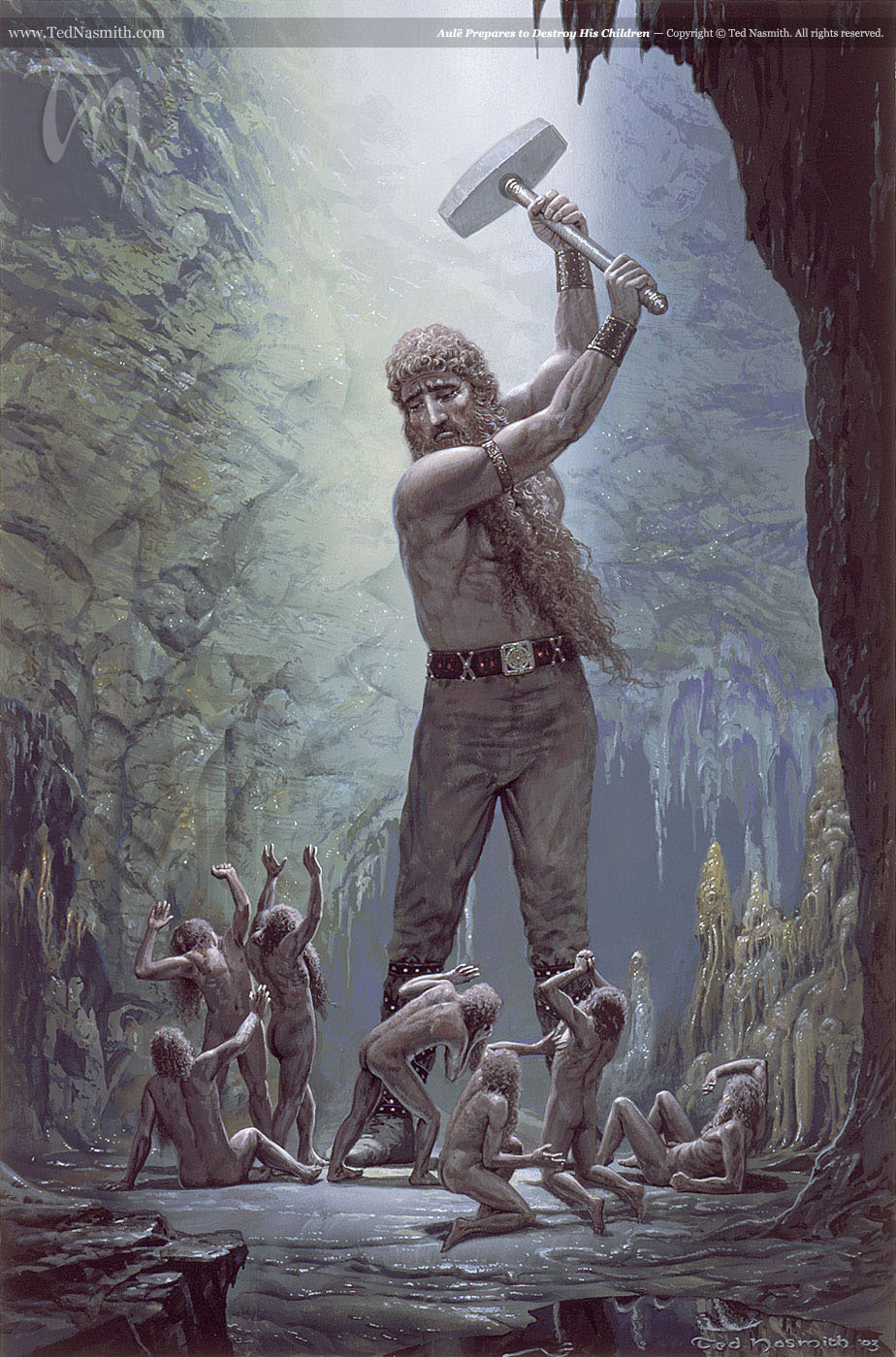
And Ráthorm had one last tale to share, which brought no comfort to my heart. For she says it is written that long, long ago in the Years of the Trees, Eru Ilúvatar forbode this hapless doom to Aulë, father of the Dwarves, with these words: "Often strife shall arise between thine and mine, the children of my adoption and the children of my choice." 7
* * *
1. "Both Noglond and Gondamon were once Elven holdings in the days of Edhelion, but was abandoned and fell into ruin when the Elves of Refuge of Edhelion fled for Duillond after Skorgrím Dourhand's treacherous assault. The dwarves later rebuilt the stronghold to their liking. The dwarf-exiles of the Lonely Mountain rebuilt them, under the leadership of Thráin and Thorin, and the Elves of Duillond welcomed them to the mountains. In these evil days, the guards of Noglond and Gondamon must be ever-vigilant against the return of the treacherous Dourhands and goblins out of the north."
- Lorebook
2. “Those of the Elven-race that lived still in Middle-earth waned and faded, and Men usurped the sunlight. Then the Quendi wandered in the lonely places of the great lands and the isles, and took to the moonlight and the starlight, and to the woods and caves, becoming as shadows and memories, save those who ever and anon set sail into the West and vanished from Middle-earth.”
- The Silmarillion, "Of Men"
3. "The hostility of (even good) Dwarves and Elves, a motive that often appears, derives from the legends of the First Age.."
- Letter 131
4. "But in far distant days the Dwarves were secretive and had few dealings with the Elves. In the West at the end of the First Age the dealings of the Dwarves of the Ered Lindon with King Thingol ended in disaster and the ruin of Doriath, the memory of which still poisoned the relations of Elves and Dwarves in after ages."
- The Peoples of Middle-earth, "Of Dwarves and Men"
5. " The Petty-dwarves. See also Note 7. The Eldar did not at first recognize these as Incarnates, for they seldom caught sight of them in clear light. They only became aware of their existence indeed when they attacked the Eldar by stealth at night, or if they caught them alone in wild places. The Eldar therefore thought that they were a kind of cunning two-legged animals living in caves, and they called them Levain tad-dail or simply
Tad-dail and they hunted them. But after the Eldar had made the acquaintance of the Naugrim, the Tad-dail were recognized as a variety of Dwarves and were left alone. There were then few of them surviving, and they were very wary, and too fearful to attack any Elf, unless their hiding-places were approached too nearly. The Sindar gave them the names Nogotheg 'Dwarflet', or Nogoth niben 'Petty Dwarf'.
The great Dwarves despised the Petty-dwarves, who were (it is said) the descendants of Dwarves who had left or been driven out from the Communities, being deformed or undersized, or slothful and rebellious. But they still acknowledged their kinship and resented any injuries done to them. Indeed it was one of their grievances against the Eldar that they had hunted and slain their lesser kin, who had settled in Beleriand before the Elves came there. This grievance was set aside, when treaties were made between the Dwarves and the Sindar, in consideration of the plea that the Petty-dwarves had never declared themselves to the Eldar, nor presented any claims to land or habitations, but had at once attacked the newcomers in darkness and ambush. But the grievance still smouldered, as was later seen in the case of Mim, the only Petty-dwarf who played amemorable part in the Annals of Beleriand."
- The War of the Jewels, "Quendi and Eldar: Appendix B. Elvish names for the Dwarves"
Note 7:
The Dwarves were in a special position. They claimed to have known Beleriand before even the Eldar first came there; and there do appear to have been small groups dwelling furtively in the highlands west of Sirion from a very early date: they attacked and waylaid the Elves by stealth, and the Elves did not at first recognize them as Incarnates, but thought them to be some kind of cunning animal, and hunted them. By their own account they were fugitives, driven into the wilderness by their own kin further east, and later they were called the Noegyth Nibin or Petty-dwarves, for they had become smaller than the norm of their kind, and filled with hate for all other creatures. When the Elves met the powerful Dwarves of Nogrod and Belegost, in the eastern side of the Mountains, they recognized them as Incarnates, for they had skill in many crafts, and learned the Elvish speech readily for purposes of traffic. At first the Elves were in doubt concerning them, believing them to be related to Orcs and creatures of Morgoth; but when they found that, though proud and unfriendly, they could be trusted to keep any treaties that they made, and did not molest those who left them in peace, they traded with them and let them come and go as they would. They no longer classed them as Moerbin, but neither did they ever reckon them as Celbin, calling them the Dornhoth ('the thrawn folk') or the Naugrim ('the stunted people').
- The War of the Jewels, "Quendi and Eldar: Author's Notes to Quendi and Eldar"
6. Feveren is refering to estel, rather than amdir:
" 'What is hope?' [Andreth] said. 'An expectation of good, which though uncertain has some foundation in what is known? Then we have none.'
'That is one thing that Men call "hope",' said Finrod. 'Amdir we call it, "looking up". But there is another which is founded deeper. Estel we call it, that is "trust". It is not defeated by the ways of the world, for it does not come from experience, but from our nature and first being. If we are indeed the Eruhin, the Children of the One, then He will not suffer Himself to be deprived of His own, not by any Enemy, not even by ourselves. This is the last foundation of Estel, which we keep even when we contemplate the End: of all His designs the issue must be for His Children's joy..."
- Morgoth's Ring, "Athrabeth Finrod ah Andreth"
7. "But Ilúvatar spoke again and said: ‘Even as I gave being to the thoughts of the Ainur at the beginning of the World, so now I have taken up thy desire and given to it a place therein; but in no other way will I amend thy handiwork, and as thou hast made it, so shall it be. But I will not suffer this: that these should come before the Firstborn of my design, nor that thy impatience should be rewarded. They shall sleep now in the darkness under stone, and shall not come forth until the Firstborn have awakened upon Earth; and until that time thou and they shall wait, though long it seem. But when the time comes I will awaken them, and they shall be to thee as children; and often strife shall arise between thine and mine, the children of my adoption and the children of my choice.’"
- The Silmarillion, "Of Aulë and Yavanna"
 |
xv |
 |