The mountain road to Thorin's Gate was long and cold, even in springtime. The sky had been grey and overcast since the three travellers departed Gondamon in the early morning, and a chill wind was blowing from the East. To the wonder of Feveren, snow began to lightly fall as they came to the waystation at Noglond. Snowfall in the Spring! He little thought it possible, even here on the eastern lee of the lofty Ered Luin; nevertheless, the green smell of the lowlands had slowly faded as the road rose towards the mountains, and now the crisp scent of snow filled the air and the wintry wind carried the faint woody perfume of fir.
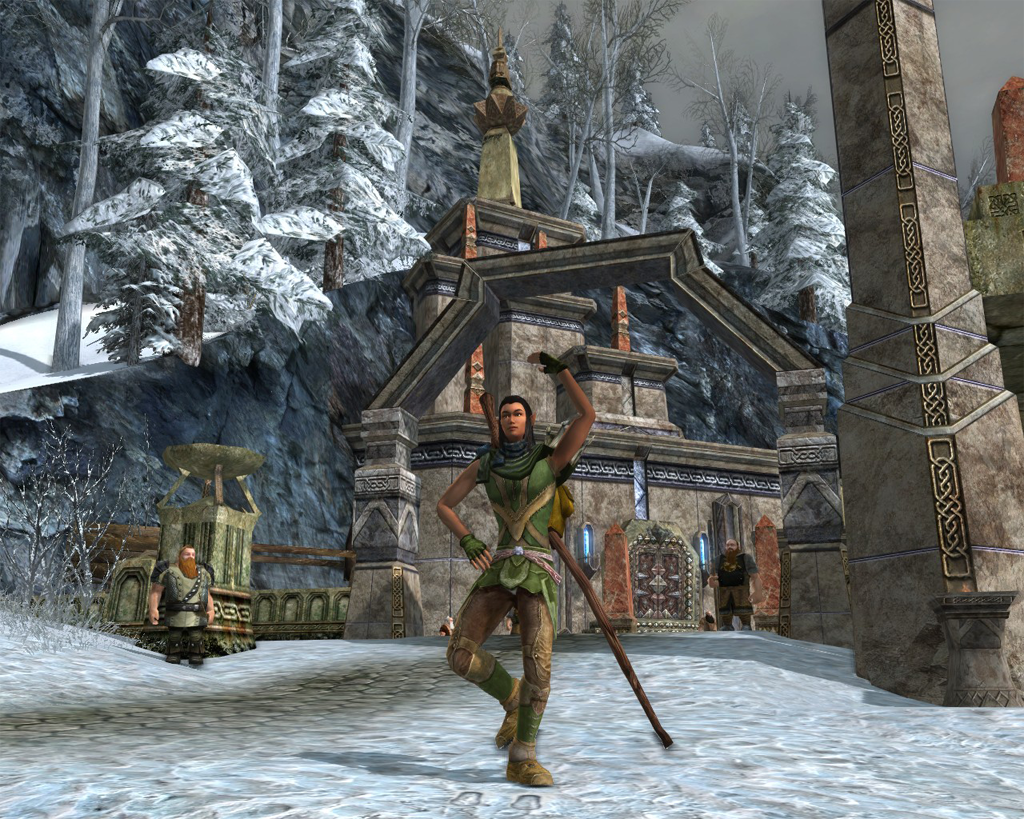
Three leagues lay between them and the gates of Gondamon, and the young Green-elf was glad to have left the shadow of strife behind him, despite the growing cold. The arched stone gateway of Noglond, deeply graven with dwarvish designs, opened onto a wide cobbled court which had been carefully swept clear of snow, and the elf-lad was amazed to behold a great tower within the station that was dolven right into the living rock of the mountainside! It was stepped with four small terraces, which in turn were adorned with pillars of red stone like spearheads, thrusting up towards the lowering clouds; atop the edifice stood a strange carven spire, adorned with a metal unknown to his woodland eye. (Indeed, his kin knew little of the Elven-smiths' art, and in their roving village neither smelter nor lasting forge were made; their meagre metal-craft lay chiefly in repairing tools and arms, or fashioning jewels and trinkets, using small makeshift foundries. Goods wrought of hard steel and the like could be readily obtained from elf-wrights in the Grey-elven towns and villages of Harlindon.)
The dwarf-haven marked the mouth of the snow-covered Vale of Thráin, named for the father of Thorin Oakenshield, and in Noglond wayfarers could find respite from the wilds: provisions, rest, and even a warm straw-strewn stable. There Leiknir, the dwarven stablemaster, was astonished to meet Gwedal Windfoot; for, he said, though Dwarves have been known to also use such steeds, long had it been since he had seen a tamed boar, let alone one beneath the seat of an Elf! The young Green-elf was quick to gainsay him with the claim that Gwedal was yet wild, but Leiknir rubbed his bald head, and watched the great boar nuzzle the elf-lad's hand. With a grin behind his trim white beard, he remarked, 'Well, he surely looks tame to me!'
Feveren laughed gaily, and after ensuring his friend was housed comfortably, he removed his pack and clad himself in his winter-wear; and he was glad of the soft light shoes made by the cunning hand of Cannasgam in Celondim, for the deepening snow upon the road had soon become a discomfort to his bare toes, even while mounted upon Gwedal's broad back. Light-footed he danced round the snowy cobblestones outside the gate, and he felt the shoes' fit was soft yet firm; but now in his heart the ceaseless whisper of the living earth fell strangely silent.
Yet Feveren was glad of the warmth, for hardy though his elf-body was, he was unused to ice and snow. Seldom did his folk venture above the tree-clad feet of Ered Lindon, for they had no cause to climb the lofty snow-capped shoulders of the mountains (but ever and anon an elven-hunter might brave the frosty vales.) And by the time the winds of winter came to snatch the last dry leaves from the bare branches, the clan had long removed westward to the foothills of their forest, where they dwelt in joy within the evergreen groves, after their merry days of harvest in the fields on the lowlands. Besides, west of the towering mountains the winters were mostly mild -- or so they had been all the years of his short life -- and their cold storms brought not snow but rain.
Grímkell Stonebearer, the commander at Noglond, was a hearty Dwarf whose forked black beard nigh reached his buckled belt, and he gave Feveren a warm welcome. And it was warm in truth, for within the stone-wrought chamber beneath the tower, he led the elf-lad to a rough wooden table beside a smouldering brazier that cast a dull red glow amidst the shadows cast by the flickering torches ensconced upon the walls. Sitting together on a low bench, the Dwarf shared hot mulled wine with the young Elf while they chewed on fresh crusty dwarf-bread and sweet honey-cakes. Feveren was in bliss: the spiced wine was rich, red and steaming; ever had he adored sweet golden honey; and his frozen toes were thawed at last. He ate a good many honey-cakes!
And they talked. Grímkell was eager for tidings from Gondamon, for news of the taking of the elf-prince had reached his ears. Thus the elf-lad told him all he knew of the sorry tale, and also the sad plight of the Elves and Dwarves of the fortress, and Grímkell was ill-pleased to learn that it was an artifice of the Dourhand Dwarves.
'Alas!' he cried, 'We have been good friends with the Elven-folk of the Blue Mountains for more than two hundred years!1 A curse on Skorgrím Dourhand!' He thumped the tabletop fiercely, spilling wine from his goblet.
'I have heard a part of the tale of the Dourhand clan,' said Feveren, reaching for another sweet cake. 'And Skorgrím is no more, I am told.'
'Clan!' spat the Dwarf. 'Faithless traitors and brigands, every one. To my mind they are not a House of the Khazâd, and thus are not worthy of the name "clan"! And Skorgrím is yet their lord, but you know not the whole abominable tale.' He sighed heavily.
'Shay on, Mashter Dwarff!' sputtered the elf-lad around the mouthful of cake he was munching. Crumbs sprayed across his lap, and to Grímkell's wonder, Glavror darted out from his hiding-place within the folds of Feveren's shabby tunic to snag his breakfast. So startled was the Dwarf that he forgot his wrath and laughed aloud with delight, and with a chirp of alarm the sparrow fluttered up into the shadows that veiled the high ceiling.
'Peace, Glavror!' called Feveren, 'Grímkell Stonebearer is a friend and the bestower of our feast. Be not aggrieved, but grateful!' The little bird flitted down onto his shoulder and regarded the Dwarf with a beady black eye. He gave a meek chirrup. 'Indeed,' grinned the young Green-elf, and he turned his face to Grímkell.
'This is Glavror,' he said with a gesture, 'of the glad greenwoods of Falathlorn. My faithful friend and fellow traveller.'
'Strange companions you keep, young Elf' said Grímkell, for from outside his door he had watched also the housing of Gwedal the boar. 'But you are a Wood-elf, anyway, though Elves of any kind are strange folk.'2
'You deem it strange to be a friend to birds and beasts?' laughed Feveren.
'Nay, not at all, for my kindred have long befriended birds that speak to us, thrushes and ravens for the most;3 but it is strange to me, lad, that you speak their tongue, or so the tales tell.'
'O!' grinned the young Green-elf, and perhaps the heady wine had loosened his tongue, for instead of feigning that this was indeed the truth as was his wont (partly in jest, and partly in keeping secret the ways of his people), to his own astonishment he said, 'Forsooth, the tales have misled you, for while our friends of fur and feather speak to me with their own voices, I speak only Elvish to them; but even in my homewood -- where our speech with them is not in Sindarin but Danian,4 the mother-tongue of my people -- still it seems that they understand our words. For the words we speak and the sounds they utter are but... tools -- I guess -- that we use to send our thought into the mind of the other. Ósanwë5 it is called in the tongue of the High-elves, "thought-sending", thus it is not the words but the thought behind them that we each grasp.' He glanced fondly at the sparrow pecking crumbs from his outstretched palm. 'But Glavror would beg to differ, I am sure!'
Grímkell guffawed, then rose from his seat and bowed. 'My thanks, Feveren son of Gladlin -- and to you, Glavror of Falathlorn -- for lightening my mood with mirth! Aye, but my heart burns hot with wrath when I think of Skorgrím Dourhand and his "house" of turncoats.' He did not return to his seat, but stood clenching his tankard; the knuckles of his ruddy hand showed white. 'He is indeed the heir of an ancient house of the Blue Mountains, but that house has long since fallen into dishonour and ruin. Yet while it is common knowledge that Skorgrím perished in his wanton assault upon Edhelion, entombed beneath a heap of fallen stone, what is little known outside my kin is that his mortal remains were long preserved, and he has but lately been raised as a dreadful wight!'
'Rhaich!' yelped Feveren, falling into his own tongue. Eyes wide, he lowered his cake unbitten. 'Verily?'
'Indeed, I heard it from the very lips of Dwalin, Master of Thorin's Hall, and he saw this evil with his own eyes: Ivar the Blood-Hand, a Gaunt-lord from the First Age and mighty in the vile art of necromancy, summoned the fell spirit that now possesses the dead dwarf-lord.'
The elf-lad's face paled and he felt a cold touch on his heart. This was evil news indeed. He had heard tell of Skorgrím's end whilst he tarried in Duillond, but of the undead naught had been said. Unease filled his mind.
There had once been a time when wights, wraiths, and phantoms had oft haunted his thought as an elf-child, for the most ancient songs of the Elves told of shadows and evil spirits that skulked in the hills of Nen Echui6 when the world was young, and these songs took root in his fertile mind.7 Also, many were the tales of evil strongholds like Tol-in-Gaurhoth and Utumno, or Angband and Angmar, whence came forth horrors unnumbered; and thence from the songs and tales they had slunk into his tender elvish-dreams.
 Feveren thought he had long outgrown his childish fears of yesteryear, but hearkening to the words of Grímkell Stonebearer had rekindled in his memory those bygone nights beset with dark dreams that featured the likes of Draugluin, and Thuringwethil, alongside demons and the undead, and other evil things.
Of this childhood torment he told no one save Faethurin, his friend, with whom he always shared his secret heart. Faethurin had kissed his brow, then clasped his small hand and said, 'Dear Faemheren, you are my sworn brother, and by my oath, no monster shall ever assail you in body or in spirit while I yet draw breath!' They were each but six years old.8
Feveren shivered. Feigning this was but from the cold air, he drew closer to the brazier and gazed into the glowing coals while he stilled his troubled thoughts. A shadow had fallen on his heart, but not only from his dark memory: for he knew now why the Dourhand Dwarves were in the sway of Angmar, and it was his guess that they knew not the true nature of their cursed lord and why he had allied with that evil land.
'But what of this Ivar Blood-Hand? Who is he and whence does he come?' he asked. 'And what is a Gaunt-lord? Some ancient horror, I deem, but never have I heard this grim name!'
'Aye,' the Dwarf replied gruffly, and sat down heavily on the bench. 'And this one hails from the Elder Days, therefore he is a very ancient evil indeed!' He sighed and glanced at the young elf's pallid face. 'Gaunt-men were once of the race of Men, enslaved in ancient days by Morgoth and then twisted and made host to fell-spirits; but the Gaunt-lords are the mightiest of these foul creatures, and are among the most powerful of the Enemy’s servants.'
The young Green-elf groaned. 'A thrall of Belegurth,9 no less! And where is he now?' he asked.
'Alas, I know not!' said the Dwarf with a shake of his head. 'Somewhere together with Skorgrím and his goblin-friends, most likely. They infest the mountains like rats, but no-one can tell where the wight makes his nest!'
Suddenly Glavror gave a loud chirp, and returned to his perch on Feveren's shoulder; the elf-lad hearkened carefully as the sparrow chirruped out a song.
'Glavror says he is at your service,' he reported, 'and it would please him to pass on a message to any thrush or raven he may chance to meet, and ask them to bring such tidings to your ear.'
The dwarf-commander clapped his hands with delight. 'Hah! Should you send me a bird with the gift of speech, I shall be forever in your debt!' he exclaimed. 'And know that a favour owed by one of Durin's Folk is not to be taken lightly.' He looked sharply at the sparrow. 'Hold a moment! So you did understand our speech, you rascal! Or did you speak in his mind, lad?'
'Not I!' laughed Feveren, and poured them both more wine.
* * *

1. "2799 Battle of Nanduhirion before the East-gate of Moria. Dáin Iron-foot returns to the Iron Hills. Thráin II and his son Thorin wander westwards. They settle in the South of Ered Luin beyond the Shire (2802)"
- The Lord of the Rings, Appendix B, "The Third Age"
(( The fall of Edhelion occured in III 2416))
2. Shamelessly cribbed from the words of Gimli in The Lord of the Rings, "The White Rider"
3. The Hobbit, "The Gathering of the Clouds"
4. Nandorin, the language of the Nandor
5. Ósanwe-kenta
6. Cuiviénen, "Water of Awakening"
7. "And indeed the most ancient songs of the Elves, of which echoes are remembered still in the West, tell of the shadow-shapes that walked in the hills above Cuiviénen, or would pass suddenly over the stars; and of the dark Rider upon his wild horse that pursued those that wandered to take them and devour them, or would pass suddenly over the stars; and of the dark Rider upon his wild horse that pursued those that wandered to take them and devour them."
- The Silmarillion, "Quenta Silmarillion: Of the Coming of the Elves and the Captivity of Melkor"
8. "The Eldar grew in bodily form slower than Men, but in mind more swiftly. They learned to speak before they were one year old; and in the same time they learned to walk and to dance, for their wills came soon to the mastery of their bodies."
- Morgoth's Ring, 'The Laws and Customs Among the Eldar'
9. "Melkor they called Morgoth 'the Black Enemy', refusing to use the Sindarin form of Melkor: Belegûr 'he that arises in might', save (but rarely) in a deliberately altered form Belegurth, 'Great Death'."
- The Peoples of Middle-earth, "The Shibboleth of Fëanor"
(Feveren's kin delighted in this wordplay, and the jest became tradition.)
 |
xvii |
 |