The presence of a strange Elf in the greenhouse had not gone unnoticed, and Feveren awoke to the sound of the heavy door being slowly opened; metal clinked, leather creaked, and heavy boots shuffled across the stone floor. Rasping voices spoke together in hurried whispers, and it seemed to him that a hushed debate was underway.
The young Green-elf peeked warily through the leafy branches of the tree in which he had passed the night. Framed in the bright daylight of the open doorway he espied a pair of armed and armoured Dwarves, their argument seemingly ended, peering into the green gloom of the chamber. Feveren pressed his brow to the tree's sturdy trunk in thanks for its hospitality, and dropped soundlessly to the ground.
'Hail, and well met!' he cried, and the two guards started at the sound. They grasped the hafts of the broad-bladed axes at their belts, squinting to find the source of the elven-voice in the dim clouded light.
'Who goes there?' called one in a husky voice. 'Show yourself!'
Feveren came forward with a smile. 'Feveren Tawardil son of Gladlin, at your service,' he said with a bow.
The dwarf-guards eyed him doubtfully, and the elf-lad saw that these were Dwarves who seldom dealt with Elven-folk. Reluctantly, the caller replied, 'Dimli, son of Dormur, at your service and your family’s.' He gave a curt bow.
Encouraged by this use of the formal dwarvish-form, Feveren's smile broadened. The other Dwarf glowered and ran his thumb along the edge of his axe, but he did not speak.
'This is a merry meeting,' the young Elf said happily, 'I thank you for my night's lodging'. Dimli son of Dormur did not return his smile.
'By order of Dwalin, son of Fundin, Master of Thorin's Hall,' he declared,'you will come with us at once to the Hall of Kings to answer for your trespass!'
Feveren laughed. 'Nay,' he said, 'but I am no trespasser! I am here to see the sights.'
'We have no liking for "sights-seers" in our city!' exclaimed Dimli. 'Least of all one that lodges in our food garden without leave.'
'And you have an ill look about you,' said the second guard at last, glancing at Feveren's travel-stained garments and bare feet (for such was the warmth of the greenhouse that he had set aside his winter gear overnight.) 'Whence do you hail? And wherefore, truly, are you here?' he demanded.
'I am from the deep greenwood of Harlindon, Master Dwarf,' replied the young Green-elf, 'where we do not share our minds with strangers!'
The Dwarf glared at him, but then with a brusque bow he growled, 'Thili son of Thodd... at your service.'
Feveren grinned. 'And now we are strangers no longer! I am at your service, friend Thili.' He bowed low pointedly. 'And your family's!' he added.
Thili scowled. 'Why have you come here?' he repeated through gritted teeth.
With his palms outspread in a sign of peace, Feveren explained: 'It is said that the kindred of Men shape solid stone into towers and strongholds which are almost equal in grace and splendour to those of the High-elves. The works of Men I have not yet beheld upon my journey, but I marvelled to see the fair cities of my high kin; yet I heard tell that the handiwork of Durin's Folk surpasses that of both Elves and Men, and I would fain learn what manner of art or craft is needed to fashion the living rock from the mountainside.'
Pride gleamed briefly in the eye of the dwarf-guard at this praise, but then he looked at Feveren askance. 'Our secrets are ours to keep, Elf, and we do not suffer spies!' he said.
'O!' cried the elf-lad. 'First I am a interloper and now I am a spy? Unkind names for a simple traveller; are there more besides?'
'Lord Dwalin shall judge you soon enough,' replied Thili with a shrug. 'But we will bind your eyes ere we take you to him, lest mischief is indeed your purpose. No sights shall you see, nor report them to your master! '
This was little to the liking of Feveren, and he opened his mouth to protest; but the thought came to him that being blindfold would shield his eyes from the dreadful vastness of the Hall. Besides, by the shortness of his captors' scraggly beards, he guessed that they themselves were but lately full-grown, and he could not abide the shame of this pair of dwarf-lads witnessing his unseemly discomfort!
'So be it, though I am no spy' he agreed. 'But I understand your mistrust, for a Shadow creeps across the West and even in my home far away we dare not by our own trust endanger our land. Thus shall I yield freely to your request, after I collect my things.'
'It was not a request!' Thili smirked. 'And you take your freedom for granted.'
'Come now,' Dimli interjected, 'the day grows old and we have little time for this. Thili, fetch the Elf's stuff.'
Thili glowered at Feveren, who pointed with his slender hand to where his gear was stowed, and Thili stamped off grumbling into the green gloom. He soon returned with the elven-pack and staff; the small pack he dropped haughtily at the elf-lad's feet, but he kept hold of the stout staff. Secretly Feveren wondered that the dwarf-guards had not searched his pack and discovered his short elven-sword. He clad himself once more in his soft stout shoes, woollen gloves, and fur-lined mantle, while the two Dwarves watched impatiently.
'Now, kneel down, Elf!' From beneath his dwarf-mail corslet Dimli drew a cloth with which he tightly bound the elf-lad's eyes. Feveren, listening hard, heard Dimli shoulder his pack; Thili was idly tapping the foot of his staff on the flagstones. Of Glavror there was nary a peep, but to the young Green-elf's keen ears there came a faint flutter of feathers from far above his head.
* * *
With the dwarf-guards flanking him on either hand, Feveren was led out onto the stone terrace of Thorin's Gates. The early morning breeze blew cold, and he knew the stonework yet lay in shadow, for the sun had not yet broached the mountains. And he smiled grimly at the folly of his plight, for it had been his hope that her bright rays would embolden his heart to overcome his discomfort of yestereve.
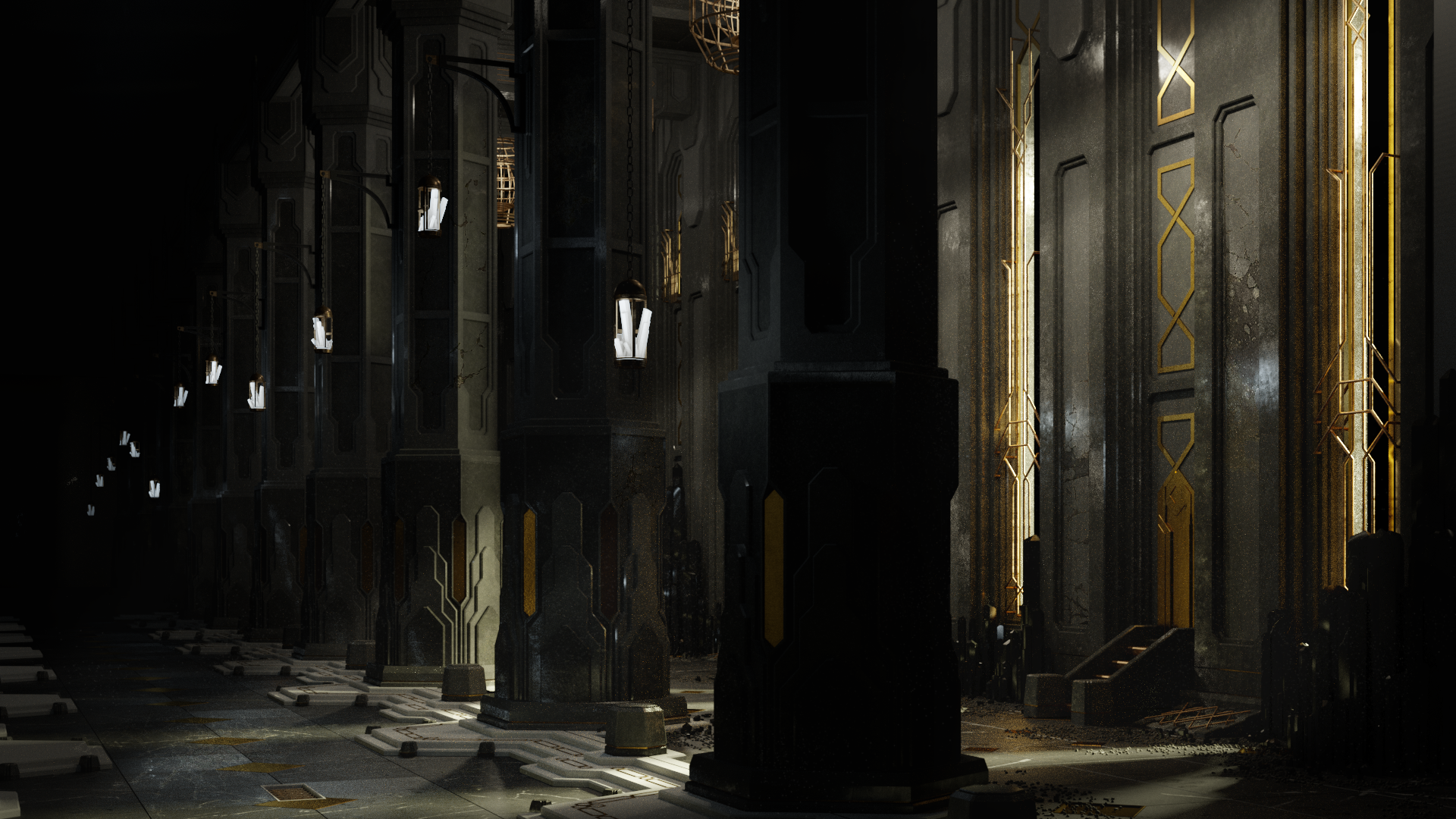
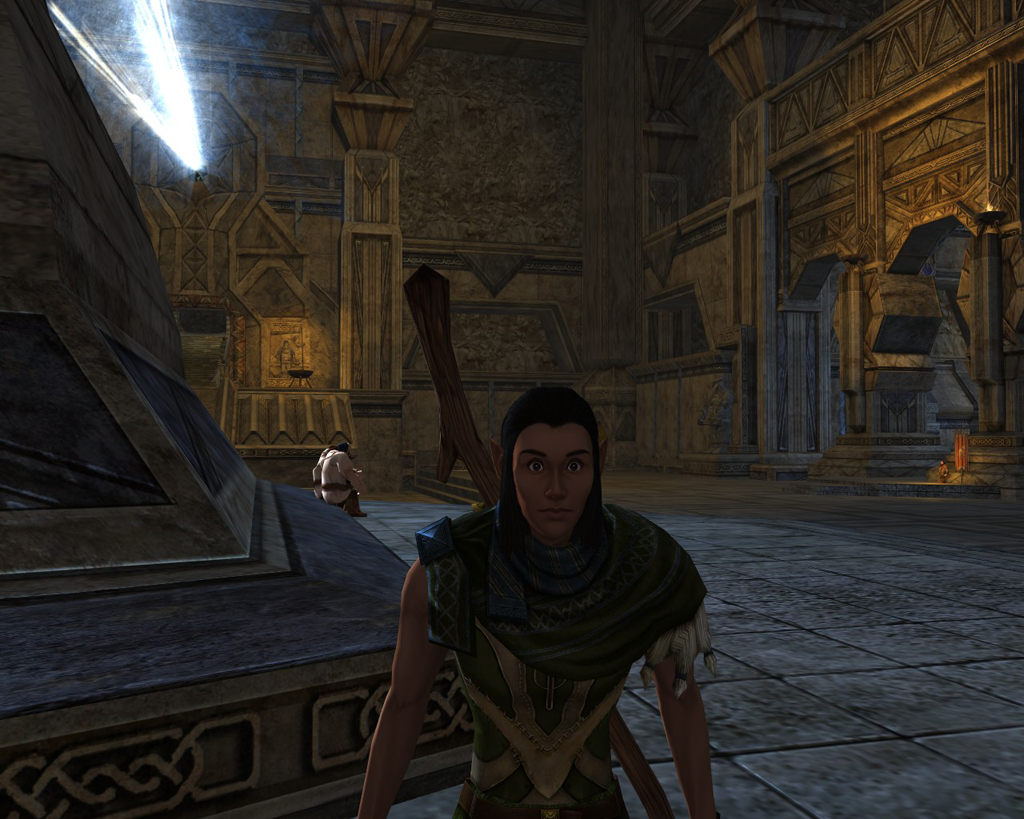
He heard again the heavy rumble of the great doors, and crossing the threshold he felt, rather than heard, the oppressive silence of the huge open hall. The wind had gone and the air felt warm upon his skin. His captors led him down a paved slope with a firm hand upon each arm, and in the darkness of his blindfold Feveren could hear faint dwarven voices speaking far away, and the thud of dwarf-boots approaching from the north.
'What in the name of the Maker1 is this?' he heard a gruff voice say.
'We have taken an elven-spy in the greenhouse,' said Dimli (or so the elf-lad guessed), and he told of Feveren's trespass and capture.
The newcomer heaved the sigh of one who has long grown weary of a particular debate. 'Unbind his eyes!' he commanded, and the blindfold was removed forthwith. The Dwarf laughed heartily.
'By the beard of Durin!' he exclaimed. 'Dimli son of Dormur, you have the eyes of a cave-troll! Your prisoner is but an elfling!'
Blinking in the dim light, Feveren saw before him an unarmed Dwarf whose raiment marked him as being of higher office than his captors. His long beard was brushed and lush.
'Take yourselves off to the armoury and relieve Vitharr who guards there,' he commanded, and Dimli and Thili laid down the Green-elf's gear and, with a resentful glance at the elf-lad, the pair hurried away up the sloping causeway. 'The Maker spare me from overeager striplings!'2 the dour Dwarf scowled as he watched them depart, then he turned to face Feveren.
'I am Thorlák, the King's Voice... although, alas, we have a king here no longer.' He neither bowed nor offered his service -- or his family's -- but instead gave the young Elf a hard look.
But Feveren paid little heed to his words, for his elven-eyes were fixed upon a statue of stone that rose to a great height before them on the far side the vast hall. That he had not seen it yestereve astonished him, for its carved bulk gleamed in the gloom, lit by a shaft of sunlight that shone from a point high above the doors behind him. Although his heart misgave him and he wondered if it was truly the Sun's bright ray, or more of the strange radiance he had beheld in the greenhouse; but it came to his mind that outside her light was yet veiled by the mountains, and besides, the doors faced southwards!
Yet again he felt the stone walls closing in, the lofty roof pressing down upon him, and a cloud of dread growing in his heart. The Dwarf turned his head to follow the elf-lad's stare.
'Aye, that is Thorin Oakenshield, King of Durin's Folk, and -- all too briefly -- fourth King under the Mountain. Do his Great Hall and mighty likeness humble you?' he said.
'A wonder they are to me and yet a trouble to my heart,' answered the young Elf, turning his wide eyes to the Dwarf.
'Indeed? Now tell me why an elf-child was hiding in our farmland?' Thorlák asked.
'I was not hiding, nor am I a child!' Feveren said cooly. 'I am Feveren son of Gladlin, and I am full-grown; indeed, eighteen times has the new moon waxed to full since the merry day I came of age. And I have travelled far from my homewood in Harlindon to behold the renowned works of the folk of Durin, but I am unused to snow and bitter frost and sought comfort in the only place in this cold realm that is green and glad, or so it seems to me.'
'It is said the Elven race is the hardiest in Middle-earth; but perhaps, through years uncounted, that tale has been overblown?'
'I am a Green-elf and my people are indeed a hardy folk, but less so than our High-elven kin3 of whom the widespread tales chiefly tell. But we see no snow in our forest home, save for the white peaks of the mountains, far away.'
'And you have no meat on your bones to keep you warm, for you are as thin as a rail, lad!' The Dwarf grasped his slender arm and gave it a shake. 'Now, whence comes this trouble to your heart which mars your wonder of our stonework?' he asked
'The walls of my abode are the living boles and boughs of trees, and its roof is of shimmering leaves and open sky,' said Feveren. 'Being beset by solid stone brings me no comfort, and to my mind your lifeless hall is much too vast!'
Thorlák chuckled grimly. 'This we call the Great Hall, yet it is but the entrance hall of our abode. Yonder past the statue of Thorin is the Hall of Kings, which will indeed daunt your callow woodland heart! Thence lies the Hall of Merchants to the west and the Maker's Hall to the east, and Thorin's Throne is in the North. Let us make haste thither!'

Swiftly he led Feveren across the wide floor of the Great Hall towards the looming statue, and all the while the amazed young Elf gazed up at it, wide-eyed in horrified wonder. But suddenly into his heart came a wild urge to climb it like a great towering tree and dance upon its crowned head, and he had to stifle the laughter that arose within his breast! But his mirth was short-lived, for passing beyond the great stone feet of Thorin Oakenshield, his startled eyes beheld the Hall of Kings in all its immense glory!
Indeed, the Great Hall was not the greatest dwarven-hall... not by far. Feveren came to an abrupt halt, and for once he was glad that his shod feet could not sense the earth beneath them, for under the burnished marble floors he was sure it must be groaning from the massive burden it bore! The elf-lad groaned in accord and sank onto his haunches with his arms clasped about his knees; his staff held loosely in his hands. Thorlák was laughing uproariously, but wiping a merry tear from his eye, he grasped the elf-lad's thin arm and lifted him to his feet as if he weighed no more than a child.
'Forgive me, young Green-elf, I meant no mockery! But for one such as I, who has ever dwelt in Dwarven-wrought halls, it is uncommonly strange to my mind to meet someone who has never yet beheld a Dwarf-delving. Are you all right?'
Feveren's tan face was wan and his feet unsteady, but he gave a weak nod and said, 'I shall live. But, I beg you, answer me this: why do your kindred build thusly?'
Thorlák smiled and stroked his long beard. 'Because we can,' he said simply. The young elf gave him a bewildered look, so he explained: 'Mahal, whom your kindred name Aulë, was our Maker when the world was young; he is a smith and a master of all crafts, and he delights in works of skill.4 He is our Father and unto his Children he passed on his skill and love of making; thus it is in our blood, you could say. But it is my guess that your folk favour Yavanna, his spouse, instead?'
Feveren nodded again. 'Aye, Aulë is much esteemed by the High-elves,5 but rarely is he in the thought or hearts of my woodland folk, and indeed we revere the works of Ivon, for she is Giver of Fruits and Queen of the Earth.' He grinned. 'But we are grateful that he wrought the Moon and Sun!'
The Dwarf chuckled throatily. 'And at least he cannot take the blame for ice and snow!'6 he said with a wink, and Feveren laughed.
'Indeed, the songs of our people tell that Belegurth in his malice unwittingly made many fair things, and thus we learn that sometimes good may, by chance, come of evil deeds... or if not by chance, then perhaps by divine design.'
'You call the First Enemy7 "Belegurth"? That is a strange name to my ears.' said Thorlák.
'Our tales say it is a name of old given to Morgoth by the High-elves in the Elder Days, for they spurned the Grey-elvish name Belegûr.8 From the bloody defeat upon the plain of Anfauglith9 there were some who fled into the greenwoods of Ossiriand and there mingled with my people;10 my kinsfolk delighted in such wordplay and used it first in jest, but now in these latter days it has become our custom.'
'It is unwise, I deem, to mock the ancient Dark Power of the North, even now. But you are a Wood-elf, though Elves of any kind are strange folk!'11
The elf-lad's eyes narrowed, for he had heard these words before and they proved his guess that Durin's Folk were all of like mind; but then suddenly into his thought came the memory of the uncanny sunlight in the green-house and the words he had written of the dwarf-commander, Grímkell Stonebearer, only yestereve:
Yet he knew me for a Wood-elf, and it pleases my heart that Durin's Folk know of the sundering of the Elves and the many diverse branches that grew from our common stem at Nen Echui. But I, myself, cannot guess between a Longbeard and a Firebeard!
'So who am I to judge?' he wondered. Indeed, his realisation that he was guilty of this same outlook -- albeit unwittingly -- shamed him, and it was grievous to his heart that the kindreds of the Mountain and the Wood were thus estranged, and each therefore knew little of the other.
'We may be esteemed for our woodcraft, but we are not renowned for our wisdom!'12 he said wryly. 'Yet to the minds of my kin, Dwarves are strange also; though I deem I have begun to learn a little of your kind.'
'Indeed?' the Dwarf smiled and stroked his beard. 'Pray tell what you have learned of my kindred, Feveren of the Forest.'
'Thus far I have met only Firebeards and Longbeards who dwell along the skirts of the Blue Mountains, but from such encounters I deem Dwarves are hardy, forthright and true, fast in friendship and enmity;13 yet also stiff-necked and heedless of all that is green and glad.' The young Elf faltered lest he had affronted his host.
'And sometimes thick-skinned, to your good fortune!' Thorlák laughed.
Feveren smiled with relief. 'But just as we Green-elves are unalike the High-elves or the Grey-elves, though they are our kin, I deem so too do the Dwarvish clans differ from each other, but in what way I do not yet know,' he said.
'Well, I mark you have keen wits and a sharp eye, youngster! Doubtless you will one day discover them for yourself, if your road leads you to the Dwarf-mansions to the East, over the Misty Mountains. And my heart tells me you purpose to travel far.'
'That is my hope,' said Feveren casting his uneasy eyes about the daunting room. 'And should my wandering feet carry me thither it would lighten my heart; if one day I grow accustomed to your lofty halls!'
'Then I share your hope, young Elf. But for now, master your dread and let your feet bring you forthwith to Thorin's Throne where Dwalin the Steward awaits your pleasure.'
The elf-lad's slender hand tightened around his stout staff of elm-wood.
'I am ready,' said he.
* * *
1. "[...] Aulë the Maker, whom [the Dwarves] call Mahal..."
- The Silmarillion, "Quenta Silmarillion: Of Aulë and Yavanna"
2. "Right before the doors he caught Azog, and there he slew him, and hewed off his head. That was held a great feat, for Dáin was then only a stripling in the reckoning of the Dwarves."
- The Lord of the Rings, Appendix A: Durin's Folk
3. "[...] those who had dwelt in Valinor and looked upon the Powers as much surpassed the Dark Elves in these things as they in turn surpassed the people of mortal race."
- The Silmarillion, "Of Men"
4. "He is a smith and a master of all crafts, and he delights in works of skill, however small, as much as in the mighty building of old."
- The Silmarillion, "Valaquenta: Of the Valar"
5. "The Noldor learned most of him, and he was ever their friend."
- The Silmarillion, "Valaquenta: Of the Valar"
6. "And Ilúvatar spoke to Ulmo, and said: ‘Seest thou not how here in this little realm in the Deeps of Time Melkor hath made war upon thy province? He hath bethought him of bitter cold immoderate, and yet hath not destroyed the beauty of thy fountains, nor of thy clear pools. Behold the snow, and the cunning work of frost! [...]
Then Ulmo answered: ‘Truly, Water is become now fairer than my heart imagined, neither had my secret thought conceived the snowflake, nor in all my music was contained the falling of the rain."
- The Silmarillion, "Ainulindalë: The Music of the Ainur"
7. "In the great battles against the First Enemy the lands were broken and ruined, and the West of Middle-earth became desolate."
- The Letters of J.R.R. Tolkien, Letter 131
8. "Melkor they called Morgoth 'the Black Enemy', refusing to use the Sindarin form of Melkor: Belegûr 'he that arises in might', save (but rarely) in a deliberately altered form Belegurth 'Great Death'."
- The Peoples of Middle-earth, "The Shibboleth of Fëanor" (note 21)
9. Battlefield of Nirnaeth Arnoediad, the Battle of Unnumbered Tears
10. "The realm of Fingon was no more; and the sons of Fëanor wandered as leaves before the wind. Their arms were scattered, and their league broken; and they took to a wild and woodland life beneath the feet of Ered Lindon, mingling with the Green-elves of Ossiriand, bereft of their power and glory of old."
- The Silmarillion, "Quenta Silmarillion: Of the Fifth Battle: Nirnaeth Arnoediad"
11. Shamelessly cribbed from the words of Gimli in The Lord of the Rings, "The White Rider" (again!)
12. "The feasting people were Wood-elves, of course. These are not wicked folk. If they have a fault it is distrust of strangers. Though their magic was strong, even in those days they were wary. They differed from the High Elves of the West, and were more dangerous and less wise."
- The Hobbit, "Flies and Spiders"
13. "And since they came in the days of the power of Melkor, Aule made them strong to endure. Therefore they are stone-hard, stubborn, fast in friendship and in enmity, and they suffer toil and hunger and hurt of body more hardily than all other speaking-folk."
- The War of the Jewels, "The Later Quenta Silmarillion: Concerning the Dwarves"

In the Hall of the Mountain King
 |
xix |
 |