Echoes in Udûn
Two months had passed, and Udûn had begun to whisper again.
Not with the crackle of forges or the grind of war machines—
but with the rumor of her.
Deorla the Herald.
Deorla the Returning Flame.
Some orcs swore they saw a pale silhouette stalking the borders.
Others claimed their patrols were cursed—missing men, silent blades in the dark, fires snuffed while their backs were turned.
Nothing decisive.
Nothing final.
But enough to unsettle.
Enough to uproot the stability Ugrukhôr demanded for his empire.
Udûn remained a wound carved into Mordor’s flesh.
Black slag mounds rose like burial hills.
Broken catapults rusted half-swallowed by ash.
The wind carried the faint ring of metal—echoes of the age when thousands labored to forge engines of war.
Deorla walked through it as if returning to an old battlefield she herself created.
A broken warg snarled at her from behind a collapsed siege tower.
She raised her hand, and the beast froze—
not because of magic,
but because it remembered a shape older than fear.
She let it live.
Let it carry the rumor further.
Her sabotage continued:
- She slashed the support beams of watchtowers.
- Poisoned one of the forge-water basins so blades came out brittle.
- Toppled a supply cart into a ravine.
- Killed only the orcs wandering alone, never groups.
- Left tracks that misled patrols into old mine shafts.
Each act small—
but together, they wove doubt into every heartbeat of Anglach’s workforce.
By the third week, the overseers screamed at empty air.
By the fifth, Ugrukhôr doubled the perimeter guard.
By the seventh, panic had spread like fever.
But still, she did not strike.
She wanted them tired.
Paranoid.
Sleepless.
She wanted the forges of Anglach to tremble at the thought of footsteps in the dark.
Then she would take them.Or at least pretend to do so, as she takes the fortress.
The Creature at the Iron Maw
One night, as Deorla traversed the ancient mining tunnel beneath Udûn—the one built during the Last Alliance—
she felt a weight in the air.
A presence.
Something was waiting at the tunnel’s exit.
Not guarding.
Not hunting.
Warning.
It crouched on all fours like a starving dog, but its limbs were too long, its face too human. The pale, leathery skin clung to sharp bones, almost glowing in the dark. Something like wings drooped from its back—thin and tattered, more membrane than flesh.
A wretched chimera of orc, ghost, and sorcerous residue.
“The Pale Herald made you,” Deorla muttered.
The creature hissed—a sound like wet iron cooling.
“No master… only hunger… only webs… only eight eyes watching…”
“The Pale Herald,” she repeated. “He’s stirring Lhingris?”
It shook violently.
“She stirs… SHE returns… and he obeys. Pale flames in the tunnels… silk in the cracks… Udûn will be last to fall when the great hunger wakes once more—”
“What do you mean she?”
The creature began to melt—skin slipping from bone.
Its voice gurgled into a strangled whisper:
“She spins again… SHE… SPINS…”
And then it collapsed into dust.
Not slain.
Dismissed.
A message delivered.
Silence followed.
But not peace.
Someone was watching Udûn from the direction of Lhingris.
Someone ancient.
Someone hungry.
Deorla wiped the dust from her boots and continued toward the cliffs overlooking Anglach.
Let her spin, she thought.
Mordor had room for more monsters.
The False Siege of Anglach
Shereg’s army arrived like a dark tide.
Easterlings in scale armor that shimmered like fresh blood.
Dunlendings wearing hides and crude metal plates, their war-cries echoing across the slag valley.
They assembled in full view of Anglach.
But Deorla had commanded restraint.
“Threaten them hard. Don’t break them however. Not yet. Let him believe this is the real siege, let him come out of his fortress finally.”
So Shereg staged a siege without delivering one:
-
Day One — The Drums Begin
The first morning of Shereg’s siege dawned under a sky the color of burned bone.
Ash drifted from high chimneys like slow-falling snow, coating every helmet, every shield, every strand of horsehair in soot. The Dunlendings muttered curses about ill omens; the Easterlings only lowered their visors and marched onward, their faces unreadable behind lacquered masks.
Shereg rode at the head of the formation, dark braids snapping in the wind, his armor a patchwork of Nurnese steel and Rhûn craftsmanship. He looked utterly in his element—like the dusty plains of Udûn had been shaped for him personally.
When the first war horns sounded, the sound rolled across the valley like a wave of thunder.
The orcs of Anglach scrambled along their battlements, shouting contradictory orders, fumbling to ready their machines. Torches flared along the battlements. Standards were raised. Siege sirens wailed.
But Shereg did not advance.
He marched his men into formation, let the shadows of their numbers fill the valley, and simply stared at the foundry fortress until the overseers began to sweat.
He did not move a single siege tower.
He refused every eager suggestion from his lieutenants to send scouts or archers forward.
He merely let dread do the work.
The orcs stayed awake the entire night, expecting a strike that did not come.
- Day Two — The Harassment Begins
On the second day, the drums returned—but this time the trebuchets were hauled forward.
Massive wooden arms creaked, groaned, and heaved stones the size of oxen into the air.
The projectiles crashed in front of Anglach’s walls in great plumes of dust, always falling just short.
The orcs roared in victory at first, thinking the invaders incompetent.
But Shereg’s trebuchets hit every miss exactly the same.
Exactly the same distance.
Exactly the same timing.
The precision unsettled even the overseers.
Then Shereg sent Dunlending skirmishers screaming toward the walls—only to have them stop, turn abruptly, and vanish behind smoke screens before the defenders could even string their bows.
A dance of provocation.
- Day Three — The Spy from other Enemies
During the third day, as the army feigned another advance, an Easterling spy disguised as a laborer slipped into Shereg’s command tent with a tarp of oil-soaked rags and a hooked dagger.
He whispered Dulgabêth’s new mantra:
“The Heir rises. Udûn is his.”
Shereg did not hesitate.
He slammed the spy onto his back, drove a boot into his ribs, and cut his throat in a single practiced motion.
But the spy’s dying words echoed:
“He will wed Lhaereth, fool. And Mordor will kneel.”
Shereg burned the body.
Then mounted its blackened skull atop a spear.
A message to both armies:
The Ash Queen commands Udûn now.
-
Day Four — The Furnace Revenant Awakens
The dawn of the fourth day split the sky with a sound like a mountain cracking.
The gates of Durthang—miles north but unmistakable—shuddered, then opened with a scream of tortured metal. A flood of heat burst forth, warping the air. Shereg looked up from sharpening his spear as the tremor rolled beneath his feet.
At first, there was only firelight.
Then he saw the figure.
Ugrukhôr.
The Captain of the Pit.
He emerged from Durthang not as a blazing furnace titan, but as a silent, armored executioner, colder and deadlier than the forges that birthed him.
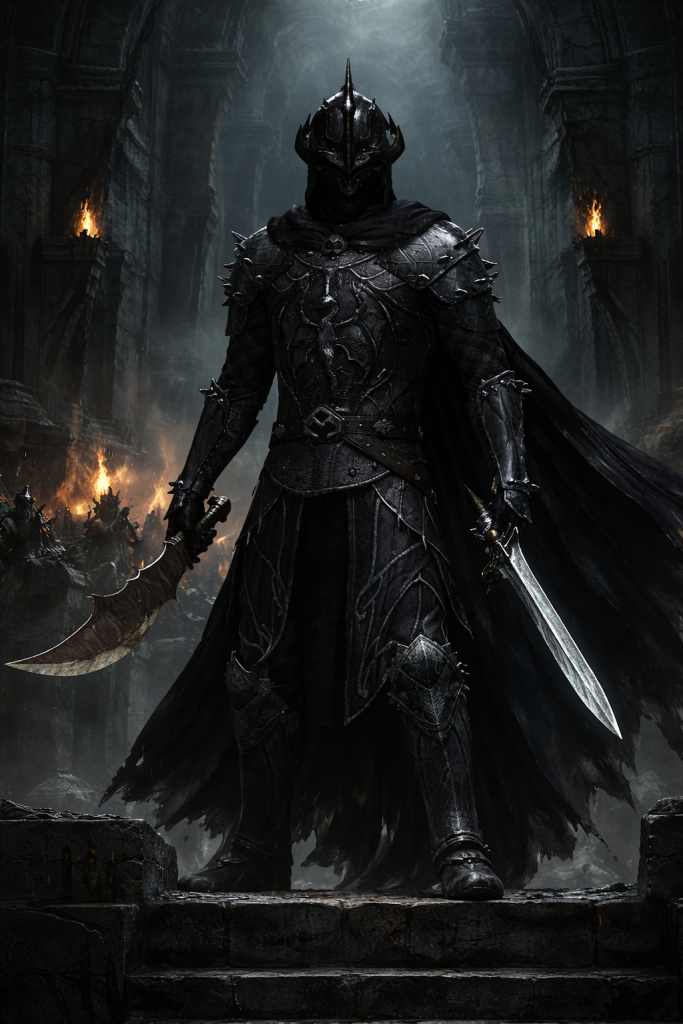
Ugrukhôr stepped through the gate encased in dark, rune-etched plate, his armor crafted with brutal precision—sharp edges, jagged spikes, and black metal that swallowed the light around him. His helm was crowned with a cruel, hooked crest, the face concealed by a visor shaped like the snarl of some iron predator.
No steam.
No roaring flames.
Just a terrible stillness, like a blade drawn in a tomb.
His pauldrons were carved in the likeness of fanged beasts, and the breastplate bore the emblem of the Eye—cracked but not erased—etched deep into the metal as though burned there centuries ago. A black cloak hung from his shoulders, frayed by years of battle, fluttering behind him like a shadow that refused to detach.
In his hands he carried his infamous paired weapons:
- a curved, serrated butcher’s blade, designed to rip through armor with savage ease
- and a long, pale knife, forged from some ancient alloy that gleamed like a shard of moonlit bone
No two weapons matched, and yet together they formed a rhythm of death known to every orc that had ever served beneath him.
His steps made no fiery tremor—only the cold, ringing thud of iron greaves on stone, echoing across Udûn like the pacing of an executioner approaching a prisoner’s cell.
And behind him surged his war-band:
Not molten monsters, but elite Uruks, clad in similar dark plate, their helms faceless, their armor decorated with spikes, ridges, and scraps of trophy bones. They marched with cruel discipline, shields lifted, blades drawn, unleashing guttural war-cries that rolled like thunder.
When Ugrukhôr raised his serrated blade, he did not roar fire.
He simply pointed, and the army charged.
A wave of steel.
Precise.
Merciless.
Unstoppable.
A true Captain of the Pit.
Shereg held the line, roaring orders in the tongue of Rhûn, dragging wounded men back into formation. Spears met steel-flesh hybrids, shields split under furnace hammers, and Dunlending war cries filled the valley with defiance.
But it was clear:
Ugrukhôr was not trying to defend Anglach.
He was trying to annihilate everything in front of it.
Every blow he struck was meant to crush, not repel.
Every breath he took exhaled steam that curled from cracks in his armor.
The Captain of the Pit had gone to war personally.
And for the first time since the fall of the Dark Lord, Udûn trembled beneath a true battle.
But this—
all of this—
was exactly what Deorla had been waiting for.
Deorla Finally Strikes
The moment Ugrukhôr’s forces emptied from Durthang, leaving only skeleton crews at the fortress, Deorla slipped into the same forgotten mining tunnel she had discovered weeks earlier.
The walls breathed heat from the forges above.
Ash drifted like fine mist.
Chains rattled in unseen chambers.
She moved through the tunnel like a memory.
A ghost returning to its grave.
When she emerged inside the lower levels of Durthang, her eyes gleamed.
Empty barracks.
Nearly silent forges.
Patrol routes cut in half.
Exactly as she predicted.
She began her work immediately.
She had spent the last two months gathering materials—blasting powders from abandoned storerooms, scrap metal from ruined smithies, unstable alchemical mixtures left forgotten. She combined them with her own knowledge, mixing volatile substances, shaping deadly traps, forging bombs designed not to destroy walls but to collapse entire corridors.
She planted tripwires on staircases.
Buried charges beneath main walkways.
Hung explosive vials above choke points.
Smeared killer toxins along weapon racks.
Tampered with the furnace controls and pressure valves.
Rigged the main gate locks to jam at the exact moment Ugrukhôr tried to retreat.
Durthang was turning into her weapon.
Her snare.
Her masterpiece.
When Ugrukhôr returned from slaughtering Shereg’s army—and he would return—
he would step into a fortress primed to drown him in fire.
In the heart of the citadel, Deorla paused and inhaled deeply.
The smell of iron.
The hum of forges.
The faint echo of war outside.
She smiled.
“Let the Captain of the Pit rage,” she whispered.
“When he comes home… his home will devour him.”
And with that, she vanished into the smoke to lay the final trap, which was herself.