The long path to the foot of Thorin's Throne echoed with the heavy tread of Thorlák's dwarf-boots upon the stone floor, but the light elven footfall of Feveren made no sound. The pair marched steadily between twin lines of towering carven pillars, which brought to the elf-lad's mind tall avenues of tree-boles within the green-shadowed halls of his home. But these pillars were hewn of finely graven stone, evenly spaced apart, and before him and on either side stretched the huge Hall of Kings. The air was still and dry (and seemed stale to his woodland nostrils), and his heart yearned to see the blue fields of the sky above and to hear the wind sighing in the branches.
Feveren followed Thorlák across the vast marble floor. Bereft of his blindfold, the young Green-elf let his long dark hair hang in lank curtains about his face and he walked with his eyes downcast -- shields from the dreadful expanse that assailed his sylvan senses. The marble shone clear as crystal, and within its burnished stone he saw reflected the tall carven pillars that held aloft the high roof, but now instead their great height seemed to reach deep down into bottomless shadow. He shifted his gaze from this abyss and watched his walking feet instead.
As they trod the length of the Hall he heard rasping dwarven-voices on either hand, and with sidelong glances from beneath his lowered lids, Feveren chanced to glimpse haggling merchants, and soldiers at swordplay or archery, and -- to his joy -- merrymakers dancing to the glad music of a minstrel's lute. They were quaffing from mugs of ale, and Feveren licked his dry lips in envy, for he had drunk nothing since yestereve, and his rude awakening that morning had not afforded him any chance to quench his thirst.
In him stirred the memory of his first taste of dwarven-ale on the green slopes of Nen Hilith, with Athal: the first Dwarf he had ever in his life beheld, and his first dwarf-friend. While he dwelt in the glade-warden's camp in the weeks that followed, the young Elf had grown quite fond of the rich and foamy brew. He wondered what choice words his friend would say if he could see Feveren now.
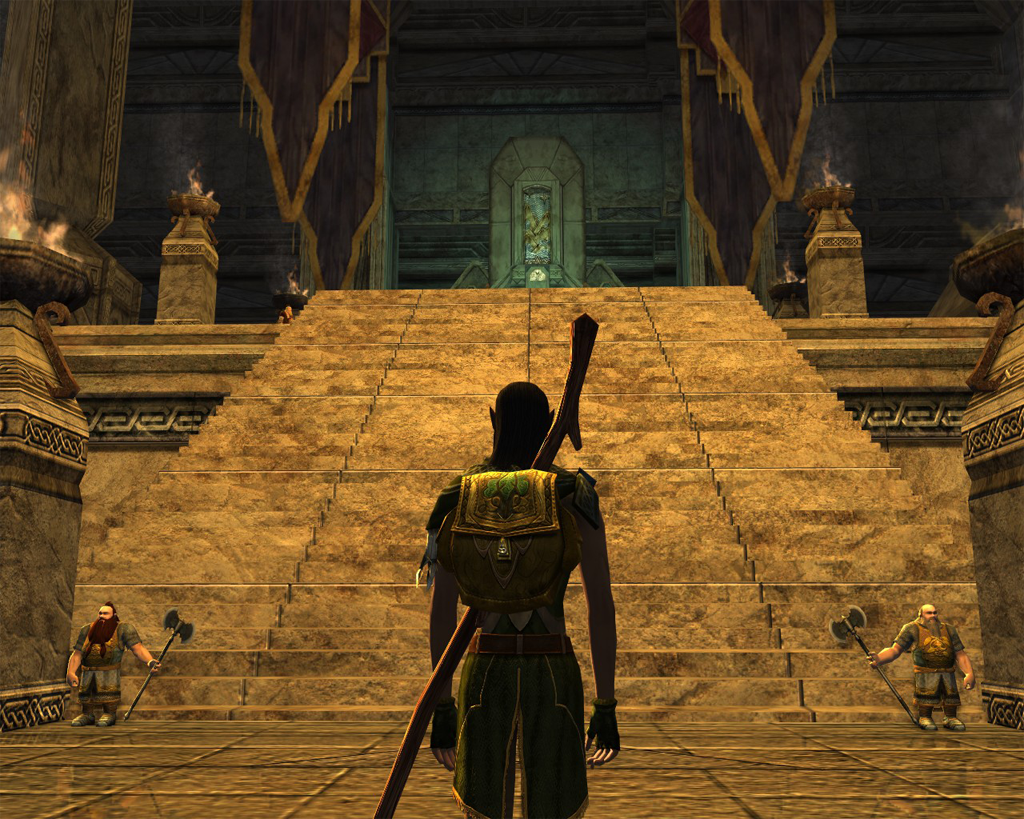
Suddenly they halted at the foot of a broad stair flanked by two tall carven pedestals. Each bore a large burning brazier, and within their flickering light stood a grim Dwarf armed with a double-edged great axe of steel; their dwarf-mail gleamed red in the firelight. Feveren marked they were much unlike the pair who had taken him in the greenhouse, and neither seemed to heed the approach of the King's Voice and a strange Elf, save for a swift dour glance in their direction.
Lifting his head, Feveren brushed aside his curtain of hair and found that the wide stone-wrought stairway completely filled his view; naught could he see passed the steep steps besides another pair of brazen braziers set on looming pedestals atop the stair, and a glimpse of yet two more behind. They made a double line of bright flame along the rising stairs, and cast a golden shimmer and flickering shadows over the graven stonework; yet between them, far back amidst the gloom of the Hall's northmost wall, burned a strange greenish light, which lit a tall monolith upon which his keen elven-eyes could descry a graven likeness of mountains shrouded in cloud
'Whither does this lead?' Feveren asked his companion, his voice hoarse, for his throat was parched from the dry and dusty air underground. He thought longingly of the almost empty wine-skin inside his pack.
'Welcome to Thorin's Throne,' declared Thorlák. 'You are brought before Dwalin, Master of Thorin's Hall; not in judgement, however, but to greet the Steward of our land as is fitting for a guest.'
Feveren coughed to clear his dry throat. 'Guest is a better name than trespasser and spy,' he grinned drily.
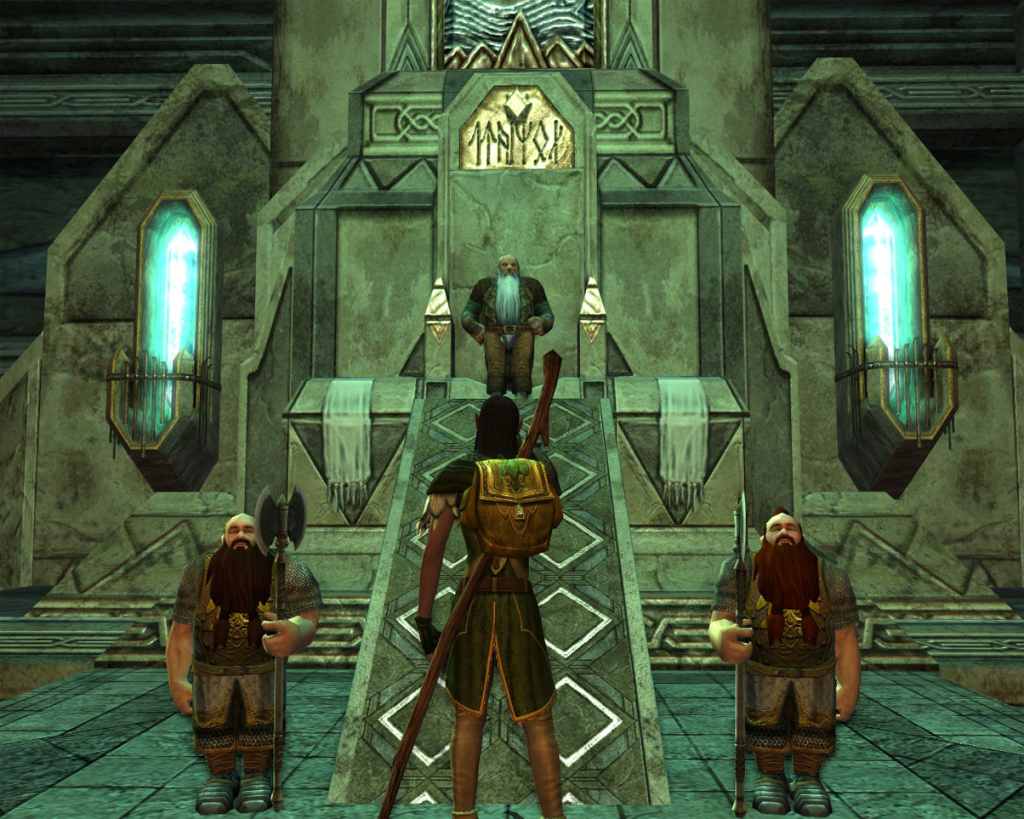
'Let us climb,' said Thorlák. He led Feveren up the stair, along a carpet of red and gold, between yet two more grim guards, and then up a broad paved ramp. There atop a narrow dais he saw a tall graven throne bathed in the soft green light of two thick glass windows on either side. Upon it sat an aged but hale dwarf-lord, his long snow-white beard was tucked into his wide buckled belt, and he was richly clad in green and tan; his eyes glinted keenly beneath his snowy brow. He was flanked by yet two more guards, broader and sterner than all the rest.
'Welcome and well met!' said the Master of Thorin's Hall, and to Feveren's astonishment the old dwarf-lord stood up to greet him in the manner of his Elven-kin!1 No other Dwarf had done likewise, least of all the only dwarf-lord he had met; indeed, Mathi Stouthand, Lord of Gondamon, had instead seemed affronted when the young Elf paid his respects.
Thus the heart of Feveren was moved by this act of courtesy and the wisdom of the Steward, and so he thought to honour Dwalin's fair-minded deed. Thus when the old Dwarf bowed in the fashion of his kindred and said, 'Dwalin at your service,' Feveren bowed low in return and replied with the secret Khuzdul words of greeting Athal had taught him while he wintered in fair Celondim: 'Zai adshânzu ra barafzu!'2
There came a fierce gasp from Thorlák beside him, for to his folk the Dwarvish tongue was a jealously guarded treasure kept hidden from all others,3 but Dwalin laughed loudly.
'By Durin's beard!' he exclaimed. 'Here we have a Dwarf-friend in our midst!'
'But, Lord Dwalin...' Thorlák objected.
Dwalin cut short his protest. 'Peace, my friend.' he said, 'I would not have it said that the courtesy of my hall is lessened of late!4 Especially by so rare a guest -- for this, I deem, is a Green-elf from beyond the Elf-havens in the south, no less, unless my old eyes deceive me?'
'You know my kin, lord?' asked the elf-lad in wonder.
'It is one thing to hear the tales of old,' Dwalin replied, 'but who indeed can know if they are true? Let us say rather that I know of them.'
Feveren laughed. 'So then, a guess!'
With a merry gleam in his eye, Dwalin replied, 'In part. But an informed one, I hope, for to my mind your manner is much akin to the Wood-elves of Mirkwood, whom I first met long ago. There was great mistrust between our kindreds then, but these days the Woodland Realm is friendly to the Kingdom under the Mountain, whence I hail, and I know them somewhat better now. Your speech and looks are much alike, yet you seem unlike them in voice and stature; and your hue tells me you share their wild blood, for they are as assorted as ripe nuts in autumn -- quite unlike the pale Grey-elves who have lordship over them!'
'O!' cried Feveren eagerly, 'it is my wish to meet my Silvan5 kin! For many Green-elves mingled with them in Eryn Galen aforetime,6 and too long have we been estranged.'
'‘Wait a moment!' said the dwarf-lord. 'What of the niceties? You have not told me who you are, lad, nor whence you hail!' He scratched his bearded chin in thought. 'Nor what purpose brings you hither,' he added.
Abashed the elf-lad said, 'Forgive me, lord! I am Feveren, son of Gladlin, son of Amathleg. Truly, we are Wood-elves also, but ever have we named ourselves Lindi in our woodland tongue. My clan dwells deep within the greenwood of Harlindon, which we name Eryn Milbar,7 but I doubt you have heard of us in either song or tale!'
The old Dwarf sat down heavily upon the stone throne and called for refreshment, to the great relief of the thirsty young Elf. 'Bombur would deem such lack a great discourtesy!' Dwalin said aside to Thorlák with a wink, and he beckoned Feveren to join him atop the narrow dias. Wine and seed-cakes were swiftly brought, with a low cushioned stool for the guest. The two Dwarves watched, bemused, as the young Elf laid down not only his staff and small pack, but also removed his mantle, gloves and shoes, making a tidy heap of his belongings behind the Steward's seat. He then perched himself upon the stool with his legs crossed, and wiggled his freed toes with delight.
Thorlák busied himself with plate and bottle, shaking his head and chortling to himself. Smiling broadly, Dwalin lifted his eyes from Feveren's bare feet and studied the strange young Elf's face. 'Verily,' he said, 'in the short years of my stewardship, rumour of a secret and woodcrafty folk in Harlindon has indeed reached my ears, even here in the northern reaches! And though my kin pay little heed to Elvish lore, I have heard some tales of Ossiriand of old, ere the ruin of Beleriand, for Dwarves played their part in them (for good or ill).'
'My forebears,' nodded the elf-lad, gratefully accepting a gilded cup brimming with rich red wine. He took a long sip and licked his lips appreciatively. 'Many are the songs and tales of my kin,' he said, 'but many also are lost to us, for in the afterdays many of my people departed into the East beyond the Ered Lindon -- Ered Luin, I mean! -- and now we are sundered by the long sweep of Time and many long leagues.'
'Well do I know that tale,' said Dwalin, 'for I myself was born in exile, far from my mountain home. Fundin, my father, of the line of King Náin, was a Dwarf of Erebor ere the coming of the Worm of Dread.'8
'So the tale is true, and Great Worms are real?' exclaimed Feveren, aghast. For on a moonless night in Nen Hilith Athal had told him a fireside tale of the evil day Smaug the Golden, the last great fire-drake, descended upon the Lonely Mountain in flames and sacked the Dwarven stronghold; thereafter, said the tale, the dragon brought ruin to the nearby town of Dale and desolation to the surrounding lands. But the wary young Elf had deemed Athal's story farfetched, doubtlessly enriched by too much dwarven-ale.
'Aye, I saw him' replied the old Dwarf earnestly. 'I was there, Feveren. I was there seven and seventy years ago. I was there the day the Old Worm fell.'9
Feveren's eyes widened, and to Dwalin's surprise he emptied his wine-cup in one long swallow, then he held out the empty vessel for Thorlák to refill.
'I deem it is more than his young mind can endure, daunted as it is already by our dwarven-mansions!' laughed Thorlák as he bent to the task; grinning in his beard, he told Dwalin of the elf-lad's discomfort in their vast halls.
'You hit the mark, Master Dwarf!' said Feveren sipping from his renewed cup. 'Verily, your great abode has stilled the song in my heart and awed my green mind; now your dark tidings make me wonder what other horrors from the ancient tales might yet endure in the Westlands.' He shook his dark head to clear his thoughts of childish dread, for ever had he harboured a deep and secret fear of the fell creatures of legend.10 He reached up and took a seed-cake from a piled silver tray. 'But your fine fare has somewhat eased the shadow that fell upon my heart!' he said, tasting it with the tip of his tongue. 'And I deem that maybe I could grow used to dwarven-delvings in time,' he looked at Dwalin with a grin, 'though I shall never love them.' He cleanly bit the cake in two and munched on it happily.
'If you are overwhelmed by our halls here in the Blue Mountains,' laughed Dwalin, 'then it is well that you have not beheld Khazad-dûm, which your kin name Moria!'
'Nebber hab I heard thoshe namesh,' said Feveren around his mouthful of cake, 'in tale or in shong.' He washed it down with a draught of wine, and gave a small belch. (While he oft wondered at the slow fading of his inborn woodland distrust of strangers, his woodland manners had certainly not yet deserted him!)
'Hammer and tongs! Never?' Dwalin exclaimed in amazement. A frown crossed his brow. 'Why, it is the greatest of all the mansions of Durin's folk in Middle-earth!' he said. He stroked his long beard and his eyes grew bright with remembrance. 'Delved by Durin in the ancient days, deep beneath Zirakzigil, Barazinbar and Bundushathûr,11 in the Mountains of Mist. Perhaps you know it as Hadhodrond of old, or the Dwarrowdelf in the Westron tongue?12 The Doors of Durin opened westwards onto the bygone elven-realm of Eregion...' The light in Dwalin's eyes faded. 'Alas, it is disheartening to speak of it,' he said, 'for it was lost to evil long ago. Still, my brother Balin undertook to regain the realm, but no new tidings have come to us in wellnigh thirty years.' A shadow passed over Dwalin's face, and he shook his hoary head sadly. 'But today let us speak of merrier things!' he said.
 Feveren was silent, for in his heart he knew well the bitter sorrow of a lost brother, and he saw in Dwalin therefore a kindred soul. He was duly saddened by the old Dwarf's distress, but Dwalin smiled and waved his hand for the young Elf to continue.
'Hadhodrond, the "Dwarf-vault", I remember, but only as a name in song,' said Feveren. 'Alas! it is not a merry tale, for it tells of the ruin of Eregion and the evil doom of the elf-wright Celebrimbor. But it speaks in passing of the friendly dwarf-realm whereby the Lady Galadriel removed to Lórinand; the High Elves called it Casarrondo, the "Dwarrow-vault", in their tongue.' He cast his eyes over the great hall that lay before them. 'And now that I have beheld the vastness of your own vaults, in my mind that name takes on a much deeper meaning!'
'Deeper indeed!' laughed Dwalin, 'But I know not the name of "Lórinand".'
'O!' said Feveren, 'it is named thus in our woodland tongue,13 and it means "valley of gold". But it is told that name was remade in bygone days, and Lothlórien it has become; yet it remains the fairest of all the dwellings of my elven-kin, or so our songs in Eryn Milbar say (though my folk beg to differ!)'
‘If Elves indeed still dwell there in the darkening world,’ remarked Thorlák.
‘Indeed, it is long since any tidings of that land crossed the leagues upon leagues betwixt Hithaeglir and Ered Lindon,’ said the elf-lad, ‘but my heart hopes the Galadhrim dwell there still.’
'Neither news nor rumour of the Golden Wood has come to me in my scant years here in Thorin's Hall, but in Erebor my folk heard from the Elves of Thranduil that it is not yet deserted,' said Dwalin. He marked the eager look on Feveren's face, and he looked keenly at the young Elf. 'But I wonder greatly what brings a Green-elf on so long a journey, for rarely do the Elves of Lindon stray this far to the north, and it is a long while since I received an elven-emissary from the Havens. And you are but an elfling... too young, I deem, to stray so far from the shelter of your woodland home!'
The elf-lad sighed, and stared into the depths of his wine-cup. The eyes reflected back at him indeed seemed very young in the strange glass-light. The wise old dwarf-lord guessed his thought. 'Be not downcast, young Green-elf,' he said, 'for I have lived now for twelve score and six years, and to my mind no elf-child is full-grown ere they see a hundred summers!' He laughed loudly. 'But it is my guess that you have seen mayhap half of that.'
Feveren glanced at Dwalin and nodded warily. The dwarf-lord smiled and tapped his nose knowingly.
'You see, lad, I know something of your kindred beyond only the Silvan Elves of Mirkwood,' the Dwarf continued, 'for upon our Quest of Erebor we had a fortnight's respite in Rivendell. In the House of Elrond I met many Elves: some grave and splendid, some as merry and carefree as children; and I learned somewhat of the customs among your Elven-kin.'
At the mention of Rivendell an eager light grew in the eyes of Feveren, but he held his tongue for once.
'Nor do I belittle your youth, despite my jest,' Dwalin said, 'for I myself was but a stripling of seven and twenty in the Battle of Azanulbizar, and was thus deemed among my folk to be too tender for fighting!14 But fight I did, and fiercely. And in that battle, Dáin Ironfoot, now King under the Mountain, slew the Orc-chieftain Azog before the East-Gate of Khazad-dûm; a mighty deed for a Dwarf of but two and thirty years! I know full well to not underrate the young!'
Feveren gazed at the old Dwarf in astonishment. 'Your words lighten my heart, lord Dwalin, and for that I give you my thanks,' he said, 'but...' He faltered and looked down at the wine-cup he held in his young hands; the glass-green light gave the glimmering copper on his bangled wrists a strange dull sheen, but the polished stones of his charms gleamed merrily. Ever did they hearten him in such moments of doubt, when comfort and counsel were needed. Feveren aforetime told his secret fears to no one save Faethurin and his own parents, yet he felt now that he could open his heart to this kindly dwarf-lord (and kindred spirit.)
'Truly, come autumn I will have seen the elm-leaves fall only two and fifty times since I was birthed beneath their golden boughs,' he said. 'Yet in my fiftieth year my clan-elders deemed me full-grown, and gave me leave to follow my purpose; but a shadow lies on my heart, for sometimes the thought comes to me that maybe they -- and I -- were too hasty, and I am indeed still too green.' He glanced uneasily at Dwalin and chewed his lip, but he did not voice the other misgiving he kept secret in his heart: that perhaps, when he was brought before the Council of Elders, the simple charm of good fortune he set upon himself had somehow been potent enough to sway their minds in his favour, despite them being much older and much wiser than he.
At first this thought had filled him with mirth, but now it troubled his heart, for he had since learned that the domination of wills is deemed by the Elves to be the greatest of all evils; nowadays when it came to him he would argue in his mind that such a deed was not possible for his gentle, fledgling art -- especially against the elders' power of will! Yet ever in his heart there remained a shadow of doubt.
'Do not let that shadow grow in your mind!' Dwalin's warning broke into his musing, and Feveren came back to the present with a start. It seemed to him for a moment that the old Longbeard had divined his thought! He blinked his startled eyes and took a draught of wine. 'No doubt your elders know you best,' Dwalin was saying, 'and perhaps they saw hidden in your heart that which you cannot; mayhap they sensed the same change in the tides of the world that we greybeards have felt in our bones. For the world is changed, young Feveren, and I forbode the time will soon come when untried hearts will shape the fortunes of all!'
* * *
1. "[Celeborn and Galadriel] stood up to greet their guests, after the manner of Elves, even those who were accounted mighty kings."
- The Fellowship of the Ring, "The Mirror of Galadriel"
2. At your service and your family's (lit.) "At service-your and family-your" - The Dwarrow Scholar Library: Everyday Phrases
3. "Yet in secret (a secret which unlike the Elves, they did not willingly unlock, even to their friends) they used their own strange tongue, changed little by the years; for it had become a tongue of lore rather than a cradle-speech, and they tended it and guarded it as a treasure of the past. Few of other race have succeeded in learning it."
- The Lord of the Rings, "Appendix F: The Languages and Peoples of the Third Age"
4. Shamelessly plifered from The Lord of the Rings, "The King of the Golden Hall" (apologies to Gandalf!)
5. "Silvan Elves: Also called Woodland Elves. They appear to have been in origin those Nandorin Elves who never passed west of the Misty Mountains, but remained in the Vale of Anduin and in Greenwood the Great; see Nandor."
- The Silmarillion, "Index of Names"
6. "Others of the Eldar there were who crossed the mountains of Ered Luin in that age and passed into the inner lands. Many of these were Teleri, survivors of Doriath and Ossiriand; and they established realms among the Silvan Elves in woods and mountains far from the sea, for which nonetheless they ever yearned in their hearts."
- The Silmarillion, "Of the Rings of Power and the Third Age"
7. "Forest Home" or "Beloved Forest Dwelling"
eryn - S. forest, wood of trees.
milbar - S. dear home, beloved dwelling [place] (PE17)
8. "Under the Mountain dark and tall
The King has come unto his hall!
His foe is dead, the Worm of Dread,
And ever so his foes shall fall..."
- The Hobbit, "The Gathering of the Clouds"
9. Apologies to Peter Jackson's The Fellowship of the Rings (and Elrond, of course!)
10. "There had once been a time when wights, wraiths, and phantoms had oft haunted his thought as an elf-child, for the most ancient songs of the Elves told of shadows and evil spirits that skulked in the hills of Nen Echui when the world was young, and these songs took root in his fertile mind. Also, many were the tales of evil strongholds like Tol-in-Gaurhoth and Utumno, or Angband and Angmar, whence came forth horrors unnumbered; and thence from the songs and tales they had slunk into his tender elvish-dreams."
- Noglond Nook
11. Celebdil (Silvertine), Caradhras (Redhorn) and Fanuidhol (Cloudyhead).
12. "The chief dwellings of the Dwarves that became known to the Sindar (though few ever visited them) were upon the east side of the Eryd Luin. They were called in the Dwarf-tongue Gabilgathol and Tumunzahar. The greatest of all the mansions of the Dwarves, Khazad-dum, beneath the Hithaeglir far to the east, was known to the Eldar only by name and rumour derived from the western Dwarves.
These names the Sindar did not attempt to adapt, but translated according to their sense, as Belegost 'Mickleburg'; Novrod, later Nogrod, meaning originally 'Hollowbold'; and Hadhodrond 'Dwarrowvault'."
- The War of the Jewels, "Quendi and Eldar: Elvish names for the Dwarves"
"Greatest of all the mansions of the Dwarves was Khazad-dûm, the Dwarrowdelf, Hadhodrond in the Elvish tongue, that was afterwards in the days of its darkness called Moria."
- The Silmarillion, Quenta Silmarillion, "Of the Sindar"
13. "Lórinand was the Nandorin name of this region (afterwards called Lórien and Lothlórien), and contained the Elvish word meaning ‘golden light’: ‘valley of gold’."
- Unfinished Tales, "The History of Galadriel and Celeborn", "Concerning Galadriel and Celeborn", Note 5
14. "Dwarves remained young - e.g. regarded as too tender for really hard work or for fighting - until they were 30 or nearly that (Dain II was very young in 2799 (32) and his slaying of Azog was a great feat)."
- The Peoples of Middle-earth, "The Making of Appendix A": "Durin's Folk"
 |
xx |
 |